Tag: LLM

  • Vibe Coding: Some How-To Advice

    Vibe Coding: Some How-To Advice

    I don’t know about you, but I’m definitely not into coding all that much. I know just enough Python to write a short script, like one that generates a poem based on a lexicon.

    As a humanities/linguistics person, I’ve never really had patience for extended periods of programming. After about five hours of dealing with code, my focus fades, and I yearn for some fresh air in the park.

    I’ve worked with Java, C++, Perl, Prolog, HTML, XML etc. in the past, but none ever went beyond school/university assignments.

    While I get bored of coding pretty fast, I still have ideas, side projects, and weird little experiments I’d love to build.

    Vibe coding makes me feel like I was born at the perfect time, as it now gives me an ability to thrive on ideas without burning out from endless manual coding.


    What Is Vibe Coding?

    Vibe coding is a fairly new term whose birth we can confidently pinpoint to this tweet by Andrej Karpathy:

    Ever since Karpathy coined this phrase, it’s been popping up all over my social media feeds (primarily Twitter/X), causing slight FOMO every time I see someone build something.

    [By the way, if you’re on Twitter/X, I’d love to connect.]

    It was also Karpathy who stated that“the hottest new programming language is English.”

    That’s basically the essence of vibe coding: You tell the machine what you want, it gets to work, and you go microwave last night’s leftovers.


    I think we’re experiencing a substantial paradigm shift. Programming isn’t what it used to be (writing boilerplate, googling syntax, manually debugging loops, etc.).

    Coding tasks becoming obsolete (click to expand)
    • Manually debugging simple errors
    • Setting up file structures from scratch
    • Looking up library documentation constantly
    • Copy-pasting Stack Overflow answers
    • Writing test cases by hand
    • Refactoring variable names manually
    • Commenting obvious code
    • Rewriting functions for different languages
    • Configuring basic build pipelines
    • Writing getters and setters
    • Typing repetitive API calls
    • Remembering regex syntax
    • Manually linting code
    • Writing basic UI layout code
    • Wrangling import statements
    • Searching for best practices
    • Translating pseudocode into real code
    • Writing “glue code” to connect APIs
    • Writing boilerplate code
    • Memorizing syntax

    If we were to put it in more elevated, conceptual terms:

    Vibe coding isn’t just about “building software”. It’s about shaping intent into form without wrestling with the medium.

    It lets you, at least to some degree, skip the laborious wrestle with details, and focus on your unique app features straightaway.

    That’s invaluable for beginners, solo entrepreneurs, and idea people like myself (at the same time it’s also disrupting software dev industry, but let’s leave that topic for another time).

    It’s more about seeing the purpose or the big picture, creating momentum, shipping/prototyping fast, all while using AI as your co-pilot (or more like a junior developer servant).

    It makes the whole process intuition/flow-driven and thus completely a different kind of activity.

    Still, if you’re not a software dev, there are important basics to consider/learn, like backend, security etc.

    The below guide breaks down the essential steps for turning ideas into functional products using AI tools at every stage.
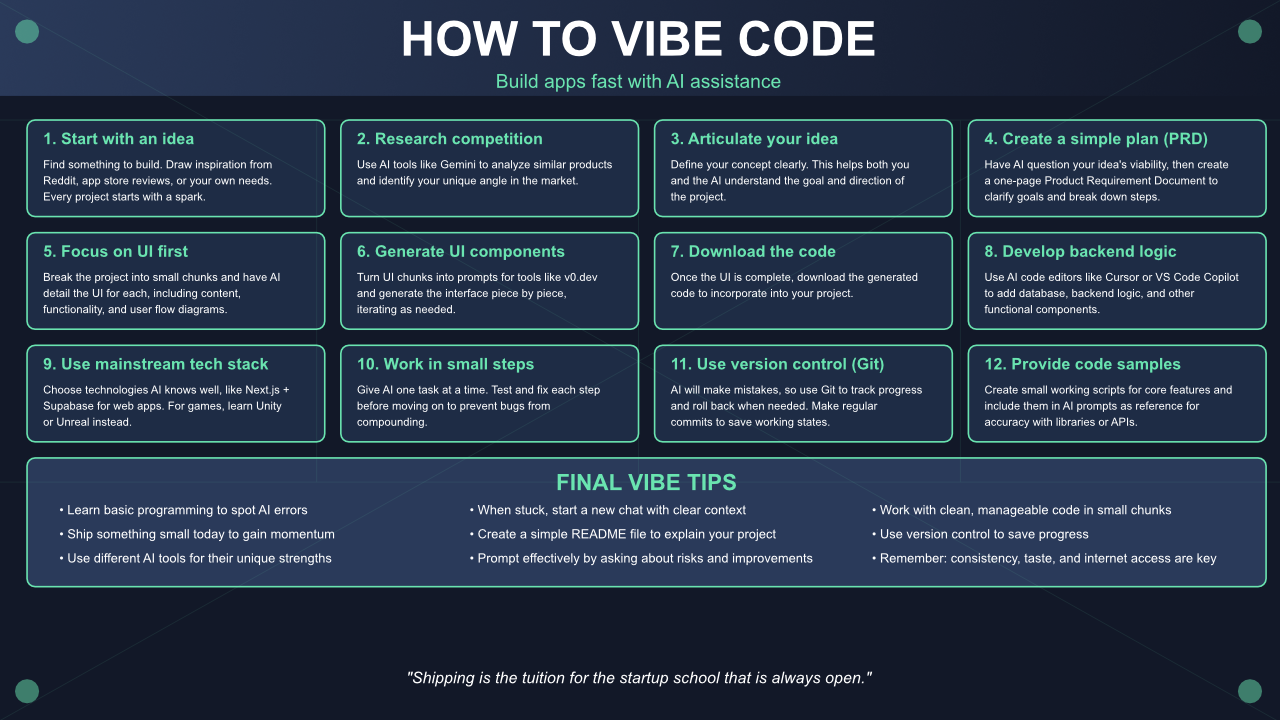
    “Educational poster” made with Claude Artifacts

    If you can imagine it, you can build it.

    For this guide I’ve put together the best advice I’ve found, directly from people who build. These tips are especially valuable for those who have never coded or finished a final product.

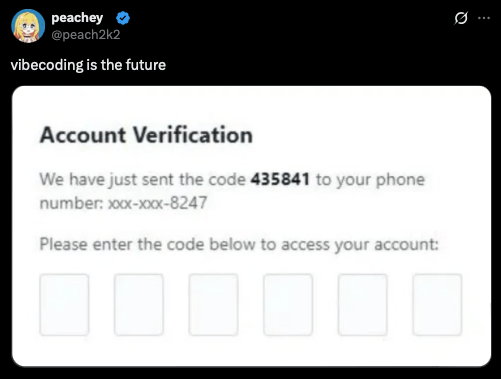
    There are plenty of possible rookie mistakes you’ll want to avoid.

    Exhibit A:
    PS: If you need more info on this topic: I’ve just published the 2nd edition of my book “Vibe Coding: Build Without Thinking”, and you can get it on Amazon.

    It contains all the info you need to successfully build any type of app, website, or platform.

    The guide below is just a summary of what you’ll find in the book.
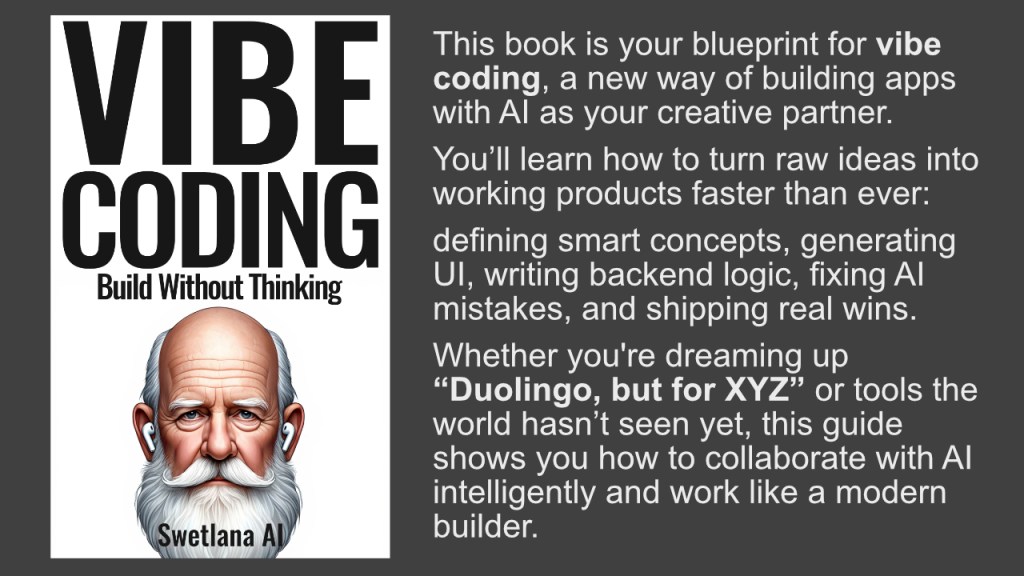
    My book about vibe coding is available now on Amazon

    Ok, ready for the guide? Here it comes.


    How To Properly Vibe Code

    Here is an ultimate “how to” list for vibe coding:

    1. Start with an idea. You need something to build. If you need inspiration, you can look at places like Reddit or app store reviews.
    2. Understand your competition. Use AI tools like Gemini to research what others in the same space are doing to identify your angle.
    3. Clearly articulate your idea. Define the basics of your concept. This will help you and the AI understand the goal.
    4. Create a simple plan (PRD). Use AI like Claude to grill your idea with questions to see if it’s viable. If it holds up, have the AI write a basic one-page plan (Product Requirement Document). This forces you to clarify what you want and breaks the work into small, clear steps. Think of it like outlining what “done” looks like for each stage.
    5. Focus on the UI first (optional but suggested). Break down the project into small, shippable chunks and have AI (like Claude) detail the UI for each, including page content, functionality, and user flow diagrams.
    6. Generate UI components with AI tools. Turn the UI chunks into prompts for tools like v0.dev and generate the user interface piece by piece, tweaking prompts as needed.
    7. Download the generated code. Once the UI is complete, obtain the code.
    8. Develop the backend logic. Use AI code editors like Cursor or VS Code Copilot to add the database, backend logic, and other functional components.
    9. Adopt a mainstream tech stack. When building a web app, consider using Next.js + Supabase because they have large user bases, many online examples, and AI is more likely to handle them correctly. Add Python if your backend needs more complex logic. For game development, learn Unity or Unreal instead of trying to “vibe-code” in less suitable environments like JavaScript for complex games. Choosing a stack AI knows well can prevent wasted time on bugs.
    10. Work in small, manageable steps. Give the AI one step at a time, rather than asking it to “do everything at once”. Test and fix each step before moving on to the next to prevent bugs from compounding. Example prompts: “Implement Step 1.1: Add Feature A” (test and fix), then “Implement Step 2: Add Feature B”.
    11. Use version control (Git). AI will inevitably make mistakes, so you need a way to roll back your code. Manual commits help you track progress and know exactly where to revert if AI creates issues.
    12. Provide working code samples. Before building a full feature, create a small working script that performs the core functionality (e.g., fetching data from an API). Once it works, save it and include it in your AI prompts as a reference to ensure accuracy with third-party libraries or APIs. This can prevent wasting time on minor mismatches.
    13. Prompt effectively.
      • Share your raw idea with the AI.
      • Ask: “what’s unclear, risky, or missing?” to refine your understanding.
      • Then: “make this resonate with [my audience/customer/community]” and provide data about them.
      • Finally: “what would [0.01% top expert in my field] do here?” to get more advanced insights.
    14. When stuck, start a new chat. Avoid getting trapped in a “copy error → paste to chat → fix → new error → repeat” cycle. If you hit this loop, open a fresh chat and clearly state what’s broken, what you expected, and what you’ve already tried. Include relevant logs, errors, and screenshots. A clean context can often resolve issues that endless retries won’t. The longer a chat history gets, the less effective the AI might become.
    15. Learn the basics of programming. While AI can write code for you, understanding fundamental programming concepts is still important. This helps you spot when the AI is incorrect and keeps your projects on track. Vibe coding can even make learning easier by doing and acquiring real-world skills while shipping projects.
    16. Ship something small today. Focus on creating and releasing a minimal viable product to gain momentum. The rest will evolve from there. Remember, shipping is the tuition for the “startup school” that is always open.
    17. Don’t be afraid to leverage different AI tools for their strengths. For example, use Gemini for research and Claude for planning and UI/UX brainstorming. You can even string together different AI agents to handle various operations.
    18. Create a simple README file. Use AI like Claude to write a basic README that explains what you are building.

    That’s it! I hope this guide will be useful to you. You can download the above poster graphic by clicking on the image.


    Watch my Swetlana AI podcast episode on this topic:

  • “Vibe Coding”: Rethinking Programming

    “Vibe Coding”: Rethinking Programming

    Vibe coding is an interesting new concept that’s gaining popularity in AI circles.

    Here’s what it’s all about:

    On Feb 2, 2025, Andrej Karpathy (ex-Tesla, ex-OpenAI = AI overlord) dropped a tweet introducing “vibe coding.” It’s a coding style where you mostly stop coding. Instead, you just… vibe.

    Let’s look at what vibe coding actually is.

    Andrej Karpathy’s tweet

    Follow the Vibe

    Karpathy says it’s about surrendering to the AI.

    No more obsessing over syntax or structure.

    Just “see stuff, say stuff, run stuff, copy-paste stuff.

    The code writes itself (sort of).

    You guide it with prompts, trust the AI to handle the rest, and don’t sweat the details.

    At its core, vibe coding represents a departure from traditional coding practices, where developers manually write, debug, and maintain code.

    Instead it relies heavily on AI tools to generate and manage code. Karpathy suggests that this method feels less like traditional coding and more like a fluid, almost magical process where the code grows beyond the developer’s direct comprehension.

    It seems like we can now trust AI to handle the details and all the nitty-gritty, so devs can focus on big ideas instead of getting lost in the technical stuff (aka the mechanics of implementation).

    Karpathy’s Vibe Coding Tools

    Karpathy’s setup relies on a few key AI tools:

    • Cursor (the interface where the code lives)
    • Claude Sonnet (the brain for deeper logic), and
    • SuperWhisper (a voice-to-text app).

    He barely touches the keyboard—just talks to the AI. Say something like, “make the sidebar padding bigger” and it just happens.

    This hands-free setup shows how AI is making coding way more accessible—even for stuff that used to be annoying or too small to bother with.

    Low Effort, High Trust

    Karpathy’s vibe coding style is basically: trust the AI, don’t overthink it.

    He hits “Accept All” without checking the changes, pastes in error messages with zero explanation, and sometimes just pokes around randomly until things work.

    It sounds chaotic, but for quick side projects or weekend experiments, it gets the job done. Fast, messy, good enough.

    That said, he admits the code can turn into a mess if you ever need to actually understand it later. So it’s fun and efficient, but only until you want to clean it up.

    The Limits

    Karpathy’s honest about the downsides. Sometimes the AI just can’t fix the bug—so you keep rewording your request or poking at the problem until it magically goes away.

    That might be fine for quick hacks, but it’s not ideal for big or serious projects where clean, secure, and reliable code actually matters. Without proper review, things can get messy fast—think spaghetti code no one wants to touch later.

    His point? Vibe coding is fun and fast, but it comes with trade-offs. If you care about long-term quality or working with a team, the chill approach might bite you later.

    The Big Picture

    Karpathy’s post clearly hit a nerve, as evidenced by the responses on X and related web discussions.

    Vibe coding indicates a broader shift: AI tools (trained on code repositories) are getting so good that more people can build software without being hardcore programmers.

    Tools like Cursor, Replit’s AI, and SuperWhisper make coding feel less like coding. It’s closer to chatting with a clever assistant that builds stuff for you. This fits right in with the low-code/no-code movement—more access, fewer barriers.

    Not everyone is a fan though. Some devs love the speed and freedom. Others worry we’re building unstable tech with no one left who understands how it works.

    Source: Reddit

    And then, of course, there’s the security aspect.

    What It Means for the Future

    So far it’s early to say, but: vibe coding might be more than a trend. It could become a whole new way of building software. With AI handling the actual labor of coding, devs can move faster, get more creative, and maybe even work more like artists than engineers.

    But there are also the big concerns (and we need to think about how to mitigate these in the future):

    • What happens to code quality?
    • Who’s responsible when AI-generated code causes problems?
    • What will it do to the job market?

    So far people are divided on this topic. Some see vibe coding as the future. Others think it’s only safe in the hands of experts like Karpathy. The rest is still coding manually.

  • How Is AI Impacting The Market (Right Now)?

    How Is AI Impacting The Market (Right Now)?

    With AI growing bigger by the hour, the market is also changing. I asked ChatGPT to summarize what’s happening with the SaaS (Software as a Service) market in November 2023, and the result is pretty comprehensive. But wait, there’s more. My next question was: “What would be a smart thing to do now?”.

    The Market Is Shaking

    For a change, I’m not discussing shenanigans here. With just two prompts (ChatGPT 4 + browsing with Bing) I found the essence of what’s going on in the market, and what to do about it.

    In case you’re not familiar with the term SaaS:

    SaaS is a software distribution model in which applications are hosted by a third-party provider and made available to customers over the internet. This model allows users to access software and its functions remotely as a web-based service, typically on a subscription basis. SaaS eliminates the need for organizations to install and run applications on their own computers or in their own data centers, reducing the expense of hardware acquisition, provisioning and maintenance, as well as software licensing, installation, and support.

    SaaS examples: Slack, Zoom, Shopify, Dropbox

    AI and SaaS Market: Summary

    Recent developments in AI SaaS throughout 2023 have been substantial, with several key trends and innovations emerging:

    1. Increased AI Adoption: The SaaS industry has experienced a surge in AI integration, driven by the growing capabilities and demand for generative AI. Around 76% of SaaS companies have adopted AI, with primary use cases including product deployment, back-office applications, and product testing. This adoption is fueled by the need for innovation, enhanced product value, and improved platform resilience​​.
    2. AI Initiatives and Product Innovations: AI initiatives in the SaaS industry are increasingly being directed by investors and boards. There’s a strong focus on integrating APIs to enable data sharing, both internally and externally, to enrich AI models. In the next 12 months, 42% of SaaS vendors are developing new AI product innovations, with practical applications in predictive analytics, deep learning, and causal AI​​.
    3. Data Quality Concerns: A significant challenge facing AI in SaaS is the quality of data used for training AI models. Approximately two-thirds of SaaS companies investing in AI may be using poor-quality data, which can lead to inaccurate predictions and potentially discriminatory outcomes. Addressing data quality issues is crucial to avoid regulatory consequences and ensure the success of AI applications​​.
    4. AI-Powered SaaS Software: AI-powered SaaS is revolutionizing business productivity. It enables automation of tasks, provides insights into customer behavior, and personalizes services. The integration of AI in SaaS is expected to lead to more sophisticated applications like predictive analytics and advanced automation​​.
    5. Advanced BI and Analytics: There’s an increasing emphasis on using AI and machine learning for enhancing business intelligence (BI) and analytics in SaaS. These tools help in identifying data patterns and trends, improving operational efficiency, and deepening understanding of customer needs and behaviors​​.
    6. Low-Code and No-Code Platforms: The rise of low-code and no-code platforms is transforming software development, allowing users without technical skills to create custom applications. This trend is especially beneficial for small and medium-sized businesses needing quick software development solutions​​.
    7. New Pricing Models: The SaaS industry is experimenting with pricing models beyond traditional subscription-based pricing. Usage-based pricing, where customers pay based on their product usage, is gaining popularity. This model offers more flexibility and can be suitable for businesses with variable SaaS product demands​​.
    8. Focus on Security and Privacy: With increasing cybersecurity threats, there’s a heightened focus on security and privacy in the SaaS industry. Advanced security measures like multi-factor authentication and encryption are becoming more prevalent. Compliance with data protection regulations is also a critical focus for SaaS providers​​.
    9. Mobile-First SaaS Solutions: The growing use of mobile devices has led to a shift towards mobile-first SaaS solutions. This trend is expected to continue, with more SaaS companies developing mobile apps that offer core features as well as mobile-specific functionalities​​.
    10. Vertical SaaS and Micro SaaS Growth: The demand for customized solutions has given rise to vertical SaaS solutions tailored to specific industries, and the emergence of Micro SaaS products, which are compact solutions designed for niche markets​​.
    11. Integration and Interoperability: The integration of different SaaS solutions to create robust ecosystems is a growing trend. This is facilitated by investments in interoperability and open APIs, enabling businesses to create personalized workflows and make better use of their data​​.

    These trends highlight the dynamic evolution of the AI SaaS industry, with a strong focus on innovation, customization, and enhanced data utilization.


    Smart Things to Do (Nov 2023)

    For a SaaS developer or someone passionate about the tech market, given the current trends in AI and SaaS, several strategic moves and areas of focus can be highly beneficial:

    1. Embrace AI and Machine Learning: Given the surge in AI adoption, it’s crucial to develop skills in AI and machine learning. Understanding how to integrate AI into SaaS applications can enhance the functionality of products and open new avenues for innovation. Specialize in areas like predictive analytics, deep learning, and causal AI to stay ahead of the curve.
    2. Focus on Data Quality: With concerns about the quality of data used in AI models, prioritize acquiring skills in data management and quality assurance. Understanding how to cleanse, process, and manage data efficiently can become a key differentiator in the success of AI-driven SaaS applications.
    3. Develop Low-Code/No-Code Solutions: Learn to create low-code/no-code platforms, as they are rapidly gaining popularity. These platforms democratize software development and can be particularly attractive to smaller businesses or non-technical users.
    4. Experiment with Pricing Models: Innovate in pricing strategies. With the rising trend of usage-based pricing, developing flexible pricing models that cater to a wider range of customers can be a smart move. This approach can be particularly appealing in markets with fluctuating demands.
    5. Enhance Security and Privacy Measures: Given the increasing focus on security, invest in learning about cybersecurity and data privacy. Developing secure and compliant SaaS solutions can not only protect against cyber threats but also build trust with users.
    6. Develop Mobile-First Solutions: With the growing prevalence of mobile devices, focusing on mobile-first SaaS solutions could be a smart strategy. Developing applications optimized for mobile use can significantly increase the accessibility and user-friendliness of your products.
    7. Specialize in Vertical SaaS: Consider specializing in vertical SaaS solutions tailored to specific industries, particularly in highly regulated fields like healthcare or finance. Customized solutions can meet the unique needs of these sectors and are often more appealing to businesses within them.
    8. Create Micro SaaS Products: Explore opportunities in Micro SaaS, which involves developing niche, agile solutions. These products can be particularly appealing in specific industries and are often easier and more affordable to develop.
    9. Invest in Interoperability and Open APIs: Focus on developing skills in creating interoperable systems and utilizing open APIs. This can help create more integrated and efficient SaaS ecosystems, providing greater value to customers.
    10. Continuous Learning and Adaptation: Stay updated with the latest trends and technologies in the SaaS and AI fields. Continuous learning and adaptation are key in a rapidly evolving tech landscape.
    11. Networking and Collaboration: Engage in networking with other professionals in the field. Collaborations can lead to new insights, partnerships, and opportunities in the fast-evolving SaaS market.

    By focusing on these areas, a SaaS developer or tech enthusiast can position themselves effectively in the current market and be well-prepared for future trends and developments.