
Vibe coding is an interesting new concept that’s gaining popularity in AI circles.
Here’s what it’s all about:
On Feb 2, 2025, Andrej Karpathy (ex-Tesla, ex-OpenAI = AI overlord) dropped a tweet introducing “vibe coding.” It’s a coding style where you mostly stop coding. Instead, you just… vibe.
Let’s look at what vibe coding actually is.

Follow the Vibe
Karpathy says it’s about surrendering to the AI.
No more obsessing over syntax or structure.
Just “see stuff, say stuff, run stuff, copy-paste stuff.
The code writes itself (sort of).
You guide it with prompts, trust the AI to handle the rest, and don’t sweat the details.
At its core, vibe coding represents a departure from traditional coding practices, where developers manually write, debug, and maintain code.
Instead it relies heavily on AI tools to generate and manage code. Karpathy suggests that this method feels less like traditional coding and more like a fluid, almost magical process where the code grows beyond the developer’s direct comprehension.
It seems like we can now trust AI to handle the details and all the nitty-gritty, so devs can focus on big ideas instead of getting lost in the technical stuff (aka the mechanics of implementation).
Karpathy’s Vibe Coding Tools
Karpathy’s setup relies on a few key AI tools:
- Cursor (the interface where the code lives)
- Claude Sonnet (the brain for deeper logic), and
- SuperWhisper (a voice-to-text app).
He barely touches the keyboard—just talks to the AI. Say something like, “make the sidebar padding bigger” and it just happens.
This hands-free setup shows how AI is making coding way more accessible—even for stuff that used to be annoying or too small to bother with.
Low Effort, High Trust
Karpathy’s vibe coding style is basically: trust the AI, don’t overthink it.
He hits “Accept All” without checking the changes, pastes in error messages with zero explanation, and sometimes just pokes around randomly until things work.
It sounds chaotic, but for quick side projects or weekend experiments, it gets the job done. Fast, messy, good enough.
That said, he admits the code can turn into a mess if you ever need to actually understand it later. So it’s fun and efficient, but only until you want to clean it up.
The Limits
Karpathy’s honest about the downsides. Sometimes the AI just can’t fix the bug—so you keep rewording your request or poking at the problem until it magically goes away.
That might be fine for quick hacks, but it’s not ideal for big or serious projects where clean, secure, and reliable code actually matters. Without proper review, things can get messy fast—think spaghetti code no one wants to touch later.
His point? Vibe coding is fun and fast, but it comes with trade-offs. If you care about long-term quality or working with a team, the chill approach might bite you later.
The Big Picture
Karpathy’s post clearly hit a nerve, as evidenced by the responses on X and related web discussions.
Vibe coding indicates a broader shift: AI tools (trained on code repositories) are getting so good that more people can build software without being hardcore programmers.
Tools like Cursor, Replit’s AI, and SuperWhisper make coding feel less like coding. It’s closer to chatting with a clever assistant that builds stuff for you. This fits right in with the low-code/no-code movement—more access, fewer barriers.
Not everyone is a fan though. Some devs love the speed and freedom. Others worry we’re building unstable tech with no one left who understands how it works.
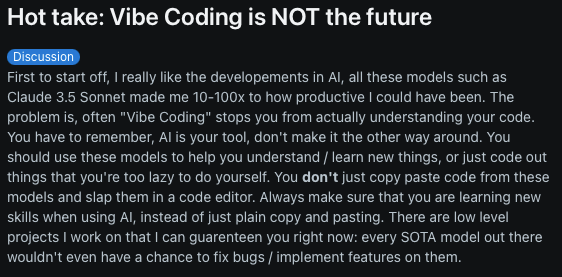
And then, of course, there’s the security aspect.
What It Means for the Future
So far it’s early to say, but: vibe coding might be more than a trend. It could become a whole new way of building software. With AI handling the actual labor of coding, devs can move faster, get more creative, and maybe even work more like artists than engineers.
But there are also the big concerns (and we need to think about how to mitigate these in the future):
- What happens to code quality?
- Who’s responsible when AI-generated code causes problems?
- What will it do to the job market?
So far people are divided on this topic. Some see vibe coding as the future. Others think it’s only safe in the hands of experts like Karpathy. The rest is still coding manually.
 Swetlana AI
Leave a comment