Blog

  • AI Agents: What They Are & How To Create Them

    AI Agents: What They Are & How To Create Them

    The term AI Agent has been popping up more and more recently. But what exactly are AI agents, and how can we create them?
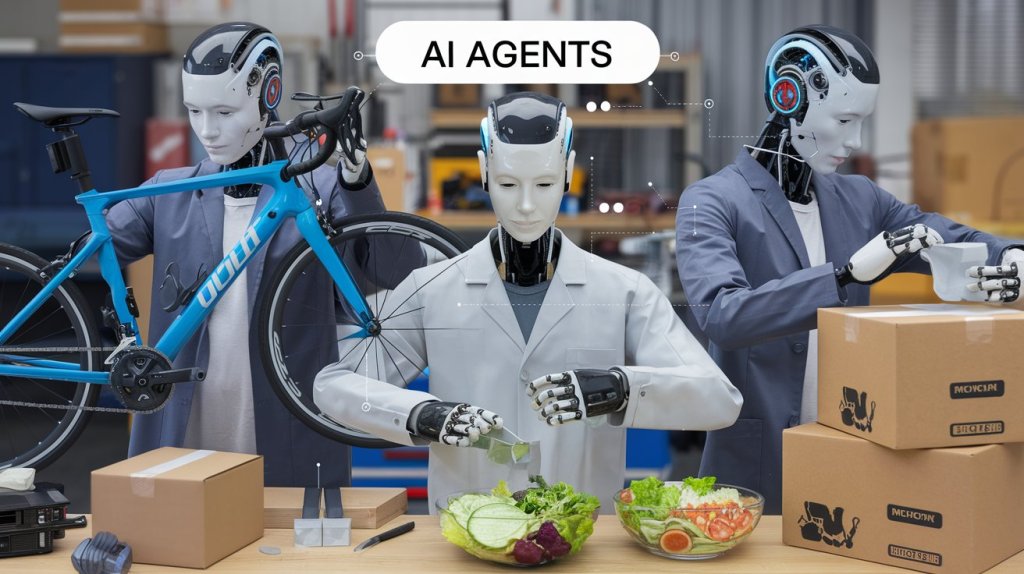
    Imagine you’re a novelist, trying to come up with the perfect plot twist.

    Now envision an AI agent as your literary companion, not just a tool but a collaborator in storytelling.

    This agent is specialized on language. It analyzes literary corpora to suggest synonyms that capture the exact emotion, propose plot developments that respect your narrative’s integrity, or offer prompts inspired by your style to help you out of writer’s block.

    It’s like having a literary critic, research assistant, and creative muse in one, enhancing your writing process by sifting through historical details for authenticity, recommending culturally resonant character names, or mimicking stylistic elements from admired authors to enrich your work, making every word count and every sentence sing.


    What Can AI Agents Do?

    Many different things! Here are some examples:

    • Automate Email Management: Sort, respond to, or schedule emails based on content or priority.
    • Personal Shopping Assistant: Make purchases or suggest items based on user preferences, style, or past behavior.
    • Smart Home Control: Manage lighting, temperature, security systems, and appliances with voice or scheduled commands.
    • Financial Advisor: Track spending, provide budget advice, invest in stocks according to user-defined strategies, or alert on market trends.
    • Health Monitoring: Remind users to take medication, track vital signs, suggest workouts, or monitor diet for nutritional balance.
    • Entertainment Curator: Recommend movies, books, music, or games based on mood, preferences, or current trends.
    • Travel Planner: Organize travel itineraries, bookings, visa reminders, and local weather updates tailored to your travel.
    • Customer Service: Handle inquiries, complaints, or support tickets autonomously across multiple communication channels.
    • Language Translation: Offer real-time translation services in conversations or for document translations.
    • Educational Tutor: Provide personalized learning experiences, quizzes, explanations, or homework assistance.
    • Project Management: Schedule tasks, manage team assignments, track progress, and predict project timelines.
    • Social Media Manager: Schedule posts, analyze engagement, respond to comments or messages, and curate content.
    • Legal Assistant: Assist in drafting simple legal documents, researching case law, or managing document due dates.
    • Event Organizer: Plan events by coordinating with vendors, managing guest lists, and sending out reminders or invitations.
    • Mental Health Support: Offer daily affirmations, mood tracking, or connect users with resources or professionals when needed.
    • Gaming Companion: Adapt game difficulty, provide tips, or even play alongside or against the user in certain scenarios.
    • Recipe and Meal Planner: Suggest recipes based on dietary restrictions, pantry inventory, or nutritional goals.
    • News Aggregator: Curate personalized news feeds, summarize articles, or alert users to breaking news relevant to their interests.
    • Job Seeker Helper: Scan job listings, match them with user’s resume, apply automatically where applicable, or prepare for interviews.
    • Environmental Monitoring: Track energy usage, suggest ways to reduce carbon footprint, or manage waste in smart homes or offices.

    What Is an AI Agent?

    Let’s get our definition straight:

    An AI agent is a type of artificial intelligence software designed to perform tasks autonomously on behalf of a user or another system.

    Here’s a more detailed breakdown of what AI agents are and what they can do:

    Definition:

    • Autonomy: AI agents operate with a degree of independence, making decisions based on their programming, data, and objectives without needing continuous human intervention.
    • Interaction: They can interact with users, other agents, or systems through various interfaces like text, voice, or API calls.

    Capabilities:

    1. Task Automation:
      • Routine Tasks: Handling repetitive tasks such as scheduling, sending reminders, or managing emails.
      • Complex Tasks: Solving problems or making decisions based on complex data analysis, like financial portfolio management or customer support.
    2. Learning and Adaptation:
      • Machine Learning: Some AI agents can learn from data, improving their performance over time. This includes recognizing patterns in user behavior to personalize services.
      • Adaptation: They adapt to new situations, environments, or user preferences, enhancing their utility.
    3. Communication:
      • Natural Language Processing (NLP): Understanding and generating human language for more intuitive interaction, like chatbots or virtual assistants.
      • Voice Recognition: Enabling voice commands, making interaction more natural and accessible.
    4. Decision Making:
      • Data Analysis: Using data to make informed decisions, from recommending products in an e-commerce setting to suggesting medical treatments based on patient data.
      • Strategy Implementation: In gaming or simulation environments, AI agents can strategize and adapt to opponents.
    5. Integration:
      • API Use: Interacting with other software systems or services, pulling data from various sources or pushing data to different platforms.
      • IoT Control: Managing smart home devices or industrial equipment by interpreting sensor data and executing commands.
    6. User Assistance:
      • Personal Assistants: Helping with daily tasks, navigation, information retrieval, or setting up appointments.
      • Customer Service: Providing 24/7 assistance in customer support scenarios, answering FAQs, or troubleshooting.

    Examples:

    • Virtual Assistants: Like Siri, Google Assistant, or Alexa, which handle a variety of user queries and commands.
    • Bots in Messaging Apps: Offering customer service, booking services, or even companionship.
    • Financial Trading Bots: Making real-time trading decisions based on market data.

    AI agents are thus versatile tools that can significantly enhance efficiency, decision-making, and user experience across various domains, from personal use to enterprise solutions.

    However, their effectiveness depends on the quality of their programming, the data they have access to, and ethical considerations in their deployment.

    The 7 Levels of AI Agents

    I’ve come across an interesting classification of AI agents. It’s outlined in this Forbes article.

    The article describes seven levels of AI agents:

    Level 1—Reactive Agents: These agents operate only in the present moment and follow pre-defined rules to respond to specific inputs. They do not retain memories or learn from past experiences. An example is a basic chatbot that answers questions based on keyword matching.

    Level 2—Task-Specialized Agents: These agents excel in narrow domains, often exceeding human performance in specific tasks by collaborating with domain experts. They are used in many modern AI applications, from fraud detection to medical imaging. For example, a task-specialized agent might power an e-commerce recommendation engine.

    Level 3—Context-Aware Agents: These agents can handle ambiguity and complexity by analyzing historical data, real-time streams, and unstructured information. Examples include systems that analyze medical data to assist doctors and systems that evaluate financial transactions to detect fraud.

    Level 4—Socially Savvy Agents: These agents understand and interpret human emotions, beliefs, and intentions, enabling richer interactions. For example, in customer service, they can identify frustration in a caller’s tone and adjust responses accordingly.

    Level 5—Self-Reflective Agents: These speculative agents would be capable of introspection and self-improvement, refining their algorithms autonomously. For example, in manufacturing, they could monitor production line inefficiencies and recalibrate machinery or workflows to enhance output.

    Level 6—Generalized Intelligence Agents: Also known as artificial general intelligence (AGI), these agents would be capable of performing any intellectual task a human can. Recent progress in large language models (LLMs) hints at the potential for AGI. For example, an AGI agent could analyze financial trends, coordinate business functions, and handle stakeholder relationships.

    Level 7—Superintelligent Agents: This hypothetical system would surpass human intelligence in all domains.Superintelligent agents could potentially discover cures for diseases, design sustainable solutions for environmental challenges, and optimize economic systems.

    How to Build an AI Agent

    Building an AI agent can be simplified using various tools and platforms, especially those designed for users with less technical expertise or for rapid prototyping.

    Steps for a Simple AI Agent Build:

    1. Define Your Goal: Clearly outline what you want your AI agent to do.
    2. Choose Your Platform: Based on your coding skills and the complexity of the task, select a platform from the no-code or low-code options mentioned.
    3. Configure or Program the Agent:
      • No-Code: Use the platform’s visual interface to set up triggers, actions, and data flows.
      • Low-Code: Follow tutorials or use existing templates, modifying them for your specific needs.
    4. Test and Iterate: Run tests to ensure the agent performs as expected. Adjust based on performance.
    5. Deploy: Once satisfied, deploy your agent within your workflow or make it accessible to users.

    These methods allow you to build AI agents with significantly less complexity than traditional coding from scratch, making AI agent development more accessible.

    To have an AI agent in simple terms, you’ll need:

    1. Input Mechanism: A way for the agent to receive information or commands, like text input, voice recognition, or data from sensors.
    2. Processing Unit: This includes:
      • AI Model: Often a machine learning or deep learning model (like neural networks) for decision-making or prediction.
      • Memory: To store data, learn from past interactions, or remember preferences.
    3. Output Mechanism: How the agent communicates results or actions, whether through text, voice, or by controlling other systems or devices.
    4. Decision-Making Logic: Rules or algorithms that dictate how the agent interprets data and decides on actions.
    5. Learning Algorithm: If the agent is meant to improve over time, you’ll need a method for it to learn from new data or feedback, like reinforcement learning or updating neural network weights.
    6. Interface or API: For integration with other systems or for user interaction, allowing the agent to operate within broader ecosystems or applications.
    7. Environment Interaction: Ability to interact with the world, whether virtual (like managing files on a computer) or physical (like controlling a smart home device).

    These components together allow an AI agent to perceive its environment, make decisions based on its programming or learning, and act autonomously to achieve specific goals or assist users.


    Here’s a guide on simpler approaches to build an AI agent:

    No-Code or Low-Code Platforms:

    1. Zapier Central:
      • Use: Zapier has introduced a no-code AI agent builder that integrates with its vast ecosystem of apps. You can create AI agents to automate tasks based on triggers from different applications.
      • Advantage: User-friendly interface, no coding required, easy to connect live data for dynamic interactions.
    2. Relevance AI:
      • Use: A platform where you can build and recruit teams of AI agents to automate tasks. It offers a no-code environment for integrating AI into business workflows.
      • Advantage: Provides a suite of integrations, tools, and AI agent templates for quick deployment.
    3. Vertex AI Agent Builder by Google Cloud:
      • Use: This tool allows you to create AI agents using natural language or a code-first approach, making it accessible for both non-coders and developers.
      • Advantage: Grounding in enterprise data with various options, including pre-built templates for rapid prototyping.
    4. Langflow:
      • Use: An open-source tool for building AI agents visually, where you can drag and drop components to create complex workflows.
      • Advantage: Comes with reusable components, ideal for those looking to experiment with agent building without coding.

    Low-Code with Some Technical Knowledge:

    • LangChain:
      • Use: While LangChain is typically used by developers, it provides frameworks and examples that can be adapted with less coding if you’re familiar with Python. There are tutorials and resources for building agents which can simplify the process for those with basic programming skills.
    • CrewAI or similar platforms:
      • Use: These platforms allow for the creation of AI agents with a focus on collaboration between multiple AI entities, which can be configured with some basic coding or through UI-based setups.
      • Advantage: Focuses on team dynamics among AI agents, potentially simplifying the management of complex tasks.

    Remember though, the simplicity of the process might come at the cost of customization or control over minute details, but for many applications, these platforms offer a good balance of simplicity and functionality.

  • You Can Just Do Things

    You Can Just Do Things

    It sounds almost too simple. But in a world where overthinking is a default setting, it’s actually profound.

    Most of us live in our heads, waiting for the perfect plan, the perfect timing, the perfect version of ourselves.

    Carl Jung would call that ego overdrive. The part of us that needs control, needs certainty, stalls action.

    But Altman’s line cuts through the noise. Just do the thing. Start before you’re ready.

    In Jungian terms, that’s how the unconscious starts speaking—through doing.

    Every time you act, especially when unsure, you wake up hidden parts of yourself: fears, strengths, shadow stuff you didn’t know was there.

    “You can just do things” is not about doing work. It’s about waking up. Moving breaks the trance. You meet parts of yourself through the act, not before it.

    Altman’s phrase is less a productivity hack and more a spiritual nudge. You don’t become whole by thinking about it. You do it by living.

    “You are what you do, not what you say you’ll do.” – Carl Jung

  • How Are People Using AI? I Asked Grok

    How Are People Using AI? I Asked Grok

    Grok is a fantastic tool for looking at what’s happening (and evaluating it), because in addition to being an AI it accesses what people are actually saying. Today I asked it about different use cases of how AI is helping people in their work.

    [Model used: Grok 2]

    My prompt:

    What are people on X saying about how AI is helping them accomplish their things? What are their use cases?

    Grok’s reply:

    People on X are discussing various ways AI is assisting them in their daily tasks and professional endeavors.

    Here are some of the use cases mentioned:

    • Content Creation: Users are employing AI for generating images, particularly for live events, indicating AI’s utility in visual content creation. AI is also used for writing and analyzing content, providing insights and creating detailed reports with case studies.
    • Programming and Technical Support: AI serves as an aid for coding, helping rudimentary programmers by providing code suggestions, explanations, and even writing code. This includes using AI to understand and generate code more efficiently.
    • Decision Making and Knowledge Repository: AI is utilized as an encyclopedia or a knowledge repository, aiding in decision-making processes by synthesizing information from various sources.
    • Productivity and Efficiency: There’s significant mention of AI enhancing productivity across different sectors like sales, support, operations, and administration. Use cases include AI agents managing inboxes, calendars, CRM systems, and other tools, saving considerable time (up to 5 hours a day) by automating routine tasks.
    • Document Conversion and Analysis: AI is praised for its ability to convert documents like PDFs into tables and perform preliminary analysis, which can then be reviewed manually for accuracy.
    • Ideation and Research: AI helps in brainstorming and research by analyzing and structuring thoughts or by providing in-depth analysis on otherwise mundane topics, enhancing creativity and strategic thinking.
    • Customer Interaction: AI is used in customer service for tasks like generating meeting minutes or handling customer support queries, improving efficiency and customer satisfaction.

    These insights from X reflect a broad spectrum of applications where AI is not just a tool but an integral part of daily professional life, enhancing both the quality and speed of work.


    My prompt:

    List up 20 specific cases you have found

    Grok’s reply:

    Here are 20 specific cases where AI is helping with tasks, as found in various discussions on X:

    1. Live Code Tutoring – AI provides real-time coding assistance and explanations.
    2. AI Research Assistant – Assists in gathering and synthesizing research data from various sources.
    3. Interactive Mixology – AI offers recipe suggestions and mixology tips for bartenders.
    4. Real-Time Piano Instruction – Provides immediate feedback and lessons to piano learners.
    5. Smart Kitchen Assistant – Helps with meal planning, recipe suggestions, and inventory management.
    6. Interactive Gaming Companion – Enhances gameplay with AI-driven interactions or strategy advice.
    7. AI Notes – Automatically transcribes and organizes notes during meetings or lectures.
    8. Voice Dictation – Transcribes spoken words into text with high accuracy.
    9. AI Slide Decks – Generates presentations based on given data or topics.
    10. Writing and Email Automation – Assists in creating content or automating email responses.
    11. Document Summarization – Summarizes lengthy documents or articles for quick review.
    12. Collaborative Research – Facilitates collaborative work by managing and analyzing shared research data.
    13. Workflow Automation – Automates repetitive workflow tasks based on user behavior patterns.
    14. AI for Email Marketing – Personalizes email campaigns and optimizes send times.
    15. Website Building – Assists in creating websites through AI-driven design and content suggestions.
    16. Image Generation – Creates visual content for various applications like marketing or social media.
    17. Copywriting – Generates ad copy, blog posts, or other content tailored to specific audiences.
    18. Meeting Notes – Automates the taking of notes during meetings, including action items and summaries.
    19. Research Tools – Provides quick answers to complex queries or aids in academic research.
    20. Productivity Apps – Integrates AI to manage calendars, emails, and other productivity tools for efficiency.

    These cases illustrate the diverse applications of AI in enhancing productivity, creativity, and efficiency across different sectors and personal tasks.

  • What Jobs Will AI Replace? And Which New Jobs Will It Create?

    What Jobs Will AI Replace? And Which New Jobs Will It Create?

    … I asked AI.

    First, here’s a summary:

    Lawyer -> AI Legal Specialist
    AI is automating repetitive legal tasks like contract review and case research, requiring specialists to manage and refine these tools.

    Journalist -> AI Content Curator
    AI can generate news articles and multimedia content faster, prompting journalists to oversee quality and context.

    Graphic Designer -> AI Prompt Engineer
    Design tools powered by AI require prompts for customization, shifting designers toward crafting effective inputs.

    Customer Service Representative -> AI Interaction Designer
    Chatbots and virtual assistants handle basic queries, creating demand for experts to design intuitive conversational flows.

    Data Entry Clerk -> Data Validation Specialist
    AI automates data entry but needs human oversight to ensure accuracy and handle edge cases.

    Factory Worker -> Robotics Coordinator
    Automation in manufacturing has introduced robots, needing specialists to program, monitor, and maintain them.

    Translator -> Machine Translation Trainer
    AI translates text more efficiently, but human experts are required to train and optimize for nuance and accuracy.

    Retail Cashier -> Retail Experience Manager
    Automated checkout systems reduce the need for cashiers but increase demand for roles enhancing customer experience.

    Travel Agent -> AI Travel Consultant
    AI tools create customized travel itineraries, but human expertise is needed to refine and personalize them further.

    Teacher -> AI Education Designer
    AI-driven platforms adapt learning to students’ needs, requiring educators to design and implement these systems effectively.

    Financial Analyst -> AI Financial Strategist
    AI models predict market trends, but analysts are needed to interpret data and integrate AI insights into strategies.

    HR Recruiter -> Talent Algorithm Manager
    AI ranks and screens candidates, requiring managers to ensure fairness and optimize algorithms for hiring processes.

    Taxi Driver -> Fleet Operations Specialist
    Autonomous vehicles reduce traditional driving roles but need operators for route management and technical oversight.

    Librarian -> Digital Knowledge Curator
    AI indexes vast amounts of digital content, shifting librarians to organize and maintain digital repositories.

    Pharmacist -> AI Prescription Advisor
    AI analyzes patient data for optimized prescriptions, requiring pharmacists to oversee its safe and ethical application.

    Interior Designer -> AI Space Planner
    AI tools generate layouts and design suggestions, requiring designers to integrate creativity and human needs.

    Advertising Copywriter -> AI Campaign Strategist
    AI generates ad content, leaving strategists to oversee creative direction and analyze campaign performance.

    Film Editor -> AI Post-Production Specialist
    AI speeds up editing and visual effects but needs human intervention for precision and storytelling alignment.

    Bookkeeper -> AI Financial Auditor
    Bookkeeping automation shifts focus to monitoring AI outputs and identifying discrepancies.

    Construction Worker -> Construction Robotics Operator
    Robots handle repetitive construction tasks, creating demand for operators to manage and troubleshoot these machines.


    Now let’s dig a bit deeper

    Lawyer -> AI Legal Specialist
    AI-powered tools are increasingly capable of performing tasks like legal research, contract analysis, and compliance checks, significantly reducing the time and cost of such activities. However, these tools require specialists to train the AI, validate its outputs, and interpret results in the context of nuanced legal frameworks. This shift allows lawyers to focus more on strategy, advocacy, and personalized client service.

    Journalist -> AI Content Curator
    With AI generating articles, headlines, and even multimedia content at scale, the role of journalists is evolving into curating and contextualizing AI-produced content. While AI excels in data analysis and rapid reporting, human judgment ensures the accuracy, ethics, and storytelling depth necessary for impactful journalism. The shift addresses the growing need for speed in news delivery while maintaining trustworthiness.

    Graphic Designer -> AI Prompt Engineer
    AI tools like generative design software require precise input to create tailored outputs. Designers are transitioning to crafting detailed prompts and understanding how to guide AI systems effectively. This shift frees up time for conceptual thinking and aesthetic decisions, as AI handles repetitive or technical design tasks. It transforms the creative process, enabling designers to act as co-creators with AI.

    Customer Service Representative -> AI Interaction Designer
    Chatbots and virtual assistants now handle a significant portion of customer inquiries, especially for routine issues. As a result, the focus has shifted to designing user-friendly interaction flows, ensuring AI tools can handle diverse queries while escalating complex issues to humans. Interaction designers bridge the gap between AI capabilities and user expectations, enhancing the customer experience.

    Data Entry Clerk -> Data Validation Specialist
    Automation has largely replaced manual data entry, but AI systems still require humans to validate data, correct errors, and handle cases where inputs deviate from expected formats. This shift is driven by the need for high-quality data in analytics and decision-making, emphasizing the importance of human oversight in maintaining accuracy and reliability.

    Factory Worker -> Robotics Coordinator
    Advanced robotics and AI are automating many manual tasks in manufacturing, increasing efficiency and precision. However, these systems require skilled coordinators to program robots, troubleshoot issues, and optimize performance. The shift represents a move from physical labor to technical expertise, enabling workers to oversee automation rather than perform repetitive tasks themselves.

    Translator -> Machine Translation Trainer
    AI translation tools are increasingly accurate and accessible, but they often struggle with cultural nuances, idiomatic expressions, and industry-specific terminology. Machine translation trainers refine AI models, ensuring they are adapted to specific languages or use cases. This shift allows translation services to scale while maintaining linguistic and cultural sensitivity.

    Retail Cashier -> Retail Experience Manager
    Automated checkout systems and self-service kiosks are replacing traditional cashier roles. However, customers still value personalized service and seamless shopping experiences. Retail experience managers focus on integrating technology while ensuring customer satisfaction, handling issues with automated systems, and enhancing in-store experiences through tailored services.

    Travel Agent -> AI Travel Consultant
    AI tools can create personalized travel itineraries, offering recommendations based on user preferences, budget, and travel history. Human consultants step in to refine these AI-generated plans, adding a layer of expertise, creativity, and customer service that AI alone cannot provide. This shift reflects the growing demand for highly customized travel experiences.

    Teacher -> AI Education Designer
    AI-powered learning platforms can adapt to students’ individual needs, offering customized lessons and assessments. Teachers are increasingly becoming designers of these AI systems, ensuring that educational content aligns with pedagogical goals and ethical standards. The shift enables educators to focus on mentoring and addressing the social and emotional aspects of learning while leveraging AI for personalized instruction.

    Financial Analyst -> AI Financial Strategist
    AI tools analyze vast amounts of financial data, identify trends, and generate predictions with incredible speed and precision. While this automates routine analysis, strategists are needed to interpret AI outputs, assess risks, and integrate insights into actionable business strategies. This shift allows human expertise to guide AI recommendations within broader financial contexts.

    HR Recruiter -> Talent Algorithm Manager
    Recruitment processes are becoming increasingly data-driven, with AI tools screening resumes, ranking candidates, and even conducting initial assessments. Talent algorithm managers ensure that these systems are fair, unbiased, and optimized for the organization’s needs. They also provide a human touch for high-stakes decisions, balancing automation with ethical and strategic oversight.

    Taxi Driver -> Fleet Operations Specialist
    Autonomous vehicles are gradually reducing the need for traditional taxi drivers, but they require operators to manage fleets, monitor vehicle performance, and address unforeseen issues. Fleet specialists ensure optimal operations, schedule maintenance, and respond to technical or customer-related concerns, enabling a smooth transition to automated transportation systems.

    Librarian -> Digital Knowledge Curator
    Libraries are transforming into digital repositories, with AI indexing and organizing massive amounts of data. Librarians now curate these digital resources, ensuring accessibility, reliability, and relevance. They also help users navigate complex information landscapes, making knowledge more accessible in an era of information overload.

    Pharmacist -> AI Prescription Advisor
    AI tools analyze patient medical records, genetics, and real-time health data to recommend optimized medication plans. Pharmacists increasingly act as advisors, verifying AI-generated recommendations for safety, accuracy, and ethical considerations while providing the human connection critical for patient trust and understanding.

    Interior Designer -> AI Space Planner
    AI design tools can create functional and aesthetic layouts based on user preferences, available space, and budget. Designers use these tools to quickly prototype and refine ideas, focusing more on personalization and creativity. The shift allows for faster project execution while maintaining a high standard of tailored design.

    Advertising Copywriter -> AI Campaign Strategist
    AI tools generate compelling ad copy and analyze campaign performance, automating much of the creative and data-driven aspects of advertising. Strategists are needed to guide the overarching vision, ensuring that campaigns align with brand identity and audience needs while leveraging AI-generated insights to refine tactics.

    Film Editor -> AI Post-Production Specialist
    AI accelerates editing tasks such as color grading, scene matching, and visual effects, allowing editors to focus on storytelling and emotional impact. Post-production specialists oversee these AI-driven processes, ensuring quality and adding human creativity to enhance the final product. This shift streamlines production workflows without sacrificing artistry.

    Bookkeeper -> AI Financial Auditor
    AI systems handle bookkeeping tasks like tracking expenses, generating reports, and categorizing transactions. Financial auditors ensure these systems are accurate, compliant, and capable of handling anomalies. They focus on validating AI outputs and providing strategic insights beyond automated reporting.

    Construction Worker -> Construction Robotics Operator
    Robots are increasingly used for repetitive tasks like bricklaying, welding, and painting. Operators oversee these machines, ensuring efficiency, safety, and adaptability to specific projects. This shift reduces physical labor demands and enhances precision, enabling workers to take on higher-value roles in construction projects.

  • AI Tools That People Love/Use The Most

    AI Tools That People Love/Use The Most

    I asked Grok to analyze people’s tweets globally, and tell me which AI tools they tend to use.

    One of Grok’s priceless features is the access to what people are saying, in real time. That’s one of the things that ChatGPT can’t do.

    So: What AI tools do people actually use? Here’s what Grok says.


    Grok Breaks Down People’s Favorite AI Tools

    Here’s a more detailed breakdown of AI tools based on their mentions and praised uses from X posts:


    Perplexity AI

    Use: Primarily used for advanced search capabilities, providing focused and academic research.

    Benefits: Users appreciate its ability to integrate with other models like Claude, offer detailed insights from specific URLs or file uploads, and its ease in sharing and managing information. It’s particularly praised for its vertical integration which allows for tailored searches.


    V0 (by Vercel)

    Use: A tool for building web UI components.

    Benefits: It’s noted for its simplicity and ease of use for frontend design, making it beneficial for those who want to quickly prototype or design web interfaces.


    Bolt, Cursor AI, Windsurf AI

    Use: These tools are generally used for coding assistance.

    Benefits: Bolt might be more suited for beginners, while Cursor and Windsurf are praised for their deep integration into the coding workflow, providing real-time code suggestions, debugging assistance, and productivity boosts. Users find these tools vital for speeding up coding tasks and improving code quality.


    Claude

    Use: General productivity, particularly for writing and technical tasks.

    Benefits: Known for its nuanced understanding of context, which makes it excellent for tasks requiring detailed or technical writing. It’s also valued for its coding assistance capabilities.


    ChatGPT

    Use: Quick queries, document creation, and general information gathering.

    Benefits: Users highlight its versatility, from answering straightforward questions to creating comprehensive documents. It’s seen as an all-purpose tool for many due to its conversational nature and broad knowledge base.


    Abacus AI

    Use: Not as widely discussed, but mentioned in contexts of general productivity or potential future use.

    Benefits: While specifics are not detailed, the mention suggests it’s viewed with optimism for its capabilities, possibly in data analysis or custom AI solutions.


    Kapwing, InVideo, Synthesia, Kling, Pixverse

    Use: Focused on video creation and editing.

    Benefits: These tools are praised for simplifying video production. Kapwing and InVideo are noted for their editing capabilities, Synthesia for AI-generated video content, and Kling and Pixverse for innovative video generation, especially in creative or marketing contexts.


    SEMrush

    Use: SEO and digital marketing.

    Benefits: Users value it for its comprehensive digital marketing tools, including SEO, content marketing, and competitive analysis, which are crucial for enhancing online visibility.


    Midjourney, DALL-E

    Use: Image generation from text prompts.

    Benefits: These are celebrated for their creative outputs, allowing users to visualize concepts or create art with high quality and diverse styles. They’re particularly useful for designers, marketers, or anyone in need of visual content.


    Canva AI

    Use: Graphic design automation.

    Benefits: By integrating AI, Canva offers features like automated design suggestions, background removal, and more, simplifying the design process for users without extensive design skills.

  • AI Reviews My Book “Learning To Cope With AI: Anti-AI Artist’s Guide”

    As opposed to musicians, who seem to be chill with AI, visual artists tend to be very emotional about this topic. Their emotions are largely negative. Hence I wrote a book, to help them understand why they feel the way they feel, and what to do about it.

    Get the book on Amazon, or on Google Play

    My book is called “Learning to Cope With AI: Anti-AI Artist’s Guide”.

    It’s made for anti-AI artists who could consider making peace with AI, by looking at the reasons why this topic makes them so emotional.

    Here’s one example of artists being emotional:

    Here’s another one:

    Why so much intensity?

    Well, traditional artists like to imagine themselves as singular geniuses in a world that needs their exclusive touch, but AI challenges this by producing creations that look like they could have come from any one of us.

    Why do you fear me, I’m just a machine (one of my AI music videos / Robot’s Lament by Swetlana AI)

    I guess my book might touch some nerves here and there, because it just needs to be said:

    AI might be pushing us into a more honest era of creativity, one that values not just skill or style but ideas and concepts that machines can’t replicate.

    Inside the book, you’ll discover:

    • Why your fear of AI is really about your identity (spoiler: it’s not about the tech)
    • How to transform your artistic anxiety into creative fuel
    • Why your “unique artistic voice” might actually be unique after all
    • Practical exercises for embracing AI without selling your creative soul
    • A surprisingly effective method for giving your AI doppelgänger a metaphorical hug

    I’ve also had NotebookLM generate a podcast about the book. Here it is:

    And here is the transcript of the podcast:

    AI Reviews Swetlana AI’s Book “Learning to Cope with AI” [NotebookLM Podcast Transcript]

    All right. So, uh, anyone else just a little freaked out by all this AI art stuff, or is it just me?

    I mean, it’s definitely, uh, shaking things up a bit.

    Shaking things up. It’s like the whole art world is having a collective existential meltdown.

    Yeah. Well, I think that’s kind of the point.

    Okay. So, maybe that’s why we’re diving into this, uh, this book today, Learning to Cope by Swetlana AI.

    Oh, yeah. The irony is not lost on me. An AI writing a self-help book for artists freaking out about AI.

    Right. It’s like the ultimate meta gag. But uh let’s back up a sec for our listeners. Who is this Swetlana AI anyway?

    So Swetlana AI is actually pretty fascinating. She’s a computational linguist, which means she understands like the nuts and bolts of language.

    Okay, so she’s not just some random algorithm spitting out platitudes.

    Nope, she’s also a writer. And get this, she’s got an art background, too.

    So she’s like a triple threat. The AI renaissance woman,

    pretty much. And in this book, she tackles six major anxieties that artists are supposedly facing thanks to AI.

    Okay, so less Skynet takes over the art world and more. Dear diary, my algorithm is making me question my existence.

    Exactly. It’s like a therapy session for the collective artistic ego.

    All right. I mean, let’s dissect this thing. So, anxiety number one, fear of ego dissolution.

    Yeah. That feeling that AI is your artistic doppelganger, churning out work in your style faster than you can say imposttor syndrome.

    It’s like looking in a mirror and seeing, I don’t know, a robot version of yourself, but with better brush strokes,

    right? And that can be pretty unsettling. So what Lana suggests that we try to reframe this anxiety?

    Reframe it. How do you reframe the feeling that your entire artistic identity is being ripped off by a computer?

    Well, she suggests thinking of AI as an extension of your creative potential. Like your shadow artist.

    Your shadow artist. Okay, that sounds a little creepy.

    Think of it as your evil twin but with better rendering skills.

    So creepy. So instead of seeing AI as competition, we’re supposed to invite it to our next gallery opening.

    She actually suggests collaborating with it. Imagine using AI to handle the technical stuff like the grunt work.

    And that frees us up to focus on like the conceptual stuff, the emotions, the things that actually make art meaningful.

    That’s the idea. AI becomes a tool to expand your artistic ego, not dissolve it.

    I mean, I get that in theory, but a lot of artists have spent years honing their craft, mastering their technique, years of blood, sweat, and tears.

    Exactly. And now they see AI spitting out photorealistic masterpieces in seconds. And it’s going to feel like a slap in the face, right? Like what’s the point of all that hard work if a computer can do it better and faster?

    That’s the second anxiety Swetlana tackles. Loss of symbolic mastery.

    Yeah. The feeling that you’ve spent years learning the secret handshake of your art form only to find out the robots have already hacked the system.

    It’s like suddenly the robots are fluent in, I don’t know, ancient Samrian or something, and you’re still struggling with basic French.

    Exactly. Swetlana argues that AI mastering technique is like a kid learning all the chess moves without understanding strategy.

    So, they can move the pieces, but they can’t actually play the game, right? True mastery comes from the meaning you infuse through those techniques, the story you tell, the emotions you evoke.

    It’s not just about technical prowess. It’s about something deeper.

    Yeah. And that’s something AI can’t replicate.

    At least not yet. But what about the fact that AI can, you know, dig up all those artistic insecurities we try to hide?

    Oh, yeah. That’s a good one. Switana calls this one embracing the shadow.

    So, it’s like AI is this giant fun house mirror reflecting back all our anxieties and self-doubt

    pretty much. It’s like confronting your artistic demons but in pixelated form.

    So, we’re talking full-blown young and nightmare fuel. I’m not sure I signed up for this.

    But here’s where Swetlana flips the script. She sees AI as a tool for self-awareness.

    Self-awareness. How does staring into the abyss of my artistic insecurities help me become more self-aware?

    By confronting those insecurities that AI triggers, you’re forced to look at those shadow selves, those darker aspects of your creative process.

    And that’s supposed to be a good thing.

    According to Swetlana, yes, facing those fears helps you clarify what really matters in your art. What makes it uniquely yours?

    Okay, so my AI induced existential crisis is actually a sign of artistic growth. This is starting to sound a little too newagy for me.

    Well, Swetlana delves into Young’s shadow concept. The idea that integrating those hidden parts of ourselves is essential for personal growth.

    Okay, but before we go fullon Yian, on our listeners. Can we at least take a break to make fun of some bad AI art? Uh,

    sure, why not?

    All right, let’s find some of the most hilariously bad AI art the internet has to offer.

    Okay, so before we get lost in the AI art hall of shame, Swetlana has another anxiety for us to unpack. The healthy kind of narcissism.

    Wait, narcissism? Isn’t that like a bad thing? You know, like I’m an artist, therefore I’m better than you kind of vibe,

    right? But Swetlana is talking about the healthy kind of narcissism. The belief in your own vision, the confidence to express it. It’s what drives creativity.

    Okay. How does that fit in with all this AI stuff? It feels like AI is triggering the opposite of healthy narcissism.

    It’s true. AI can make artists feel threatened, like their turf is being invaded.

    It’s like everyone’s suddenly building a wall around real art and demanding that AI pay for it.

    Exactly. It’s that defensive kind of narcissism. But Swetlana’s point is we need to reclaim the healthy kind, the kind that celebrates our uniqueness and uses AI as a foil to refine in our own voice.

    So instead of crying to our paint pallets, we should be thanking the robots for showing us how awesome we are.

    It’s more about recognizing that AI challenges us to go deeper, to move beyond just mimicking a style and figure out what truly makes our art meaningful.

    Okay, but can we address the elephant in the room? This whole AI thing feels like a preview of our dystopian future.

    Robots taking over the world.

    Exactly. They’ll steal our jobs, our art, and eventually our souls.

    Islana going to give us tips on building underground art bunkers? Not quite. She dedicates a whole chapter to making peace with the future, but no bunker blueprints, unfortunately.

    So, what does she say? Should we just accept our robot overlords and start painting portraits of them?

    She encourages us to separate our fears about societal change from AI itself. AI is a tool just like any other. It’s how we use it that matters. Okay, but who’s doing the choosing? Maybe we should be more worried about the humans behind the AI, you know, the ones programming these things.

    That’s an interesting point, and it leads to the final anxiety. Swat Lana tackles redefining creative authority.

    Oh, here we go. Time to stage an art world coup and reclaim our rightful place as the masters of creativity.

    Not so fast. Swetlana uses an interesting analogy here. The parent child relationship.

    Okay, I’m intrigued. How does that apply to AI and art?

    She says some artists see AI as this all- knowing parent figure, this authority that stifles creativity. But instead of rebelling, she argues that we should focus on differentiating ourselves. So, it’s like kids figuring out their own path, developing their own sense of self, even if their parents are like super geniuses or something.

    Exactly. It’s about embracing what makes us us, even if it’s messy and unpredictable. Those are the things AI can’t replicate.

    Okay. I’m starting to see a pattern here. So, what Lana seems to be saying that instead of freaking out about AI, we should be using it as a tool for self-discovery.

    Yeah. It’s like, thanks robots for holding up this giant mirror to my artistic soul.

    Now, if you’ll excuse me, I have some deep thinking to do.

    Exactly. So, it’s not about fighting the robots. It’s about figuring out how to dance with them.

    And maybe even teach them a few new moves along the way. Who knows? Maybe AI will help us unlock some hidden creative potential we didn’t even know we had.

    Hold on. Are you saying the robots are going to make us better artists?

    It’s possible. Think of it as a forced evolution. AI is shaking things up, forcing us to confront some hard questions about what it means to be creative in a world where the lines between human and machine are blurring.

    Okay, this is a lot to process. this

    maybe we should give our listeners a moment to digest all of this before we you know drop the mic and blow their minds with the final takeaway.

    Okay, so back to the big question. What does art even mean in this brave new world of AI generated masterpieces?

    Right? Is it still art if a robot made it? Does it have the same soul? Do we even care?

    It’s like what if we found out that the Mona Lisa was actually painted by a Roomba? Would it still be a masterpiece?

    I mean it would definitely be a more impressive feat of engineering, but yeah, the whole concept of artistic genius kind of goes out the window. So, are we like doomed to become irrelevant, churning out fingerpaintings in a world where robots are the new Picassos?

    Well, Sweat Lana doesn’t think so. She actually believes that AI can enhance human creativity. It’s like this weird alien force pushing us to evolve.

    To evolve. Do we need to like merge with the machines to unlock some higher level of artistic consciousness? Yeah.

    Become cyborgs or something?

    Not exactly. It’s more about embracing the possibilities that AI opens up. using it as a tool to expand our creative horizons.

    Okay. But how do we do that? Do we start by like teaching robots to appreciate the finer points of abstract expressionism?

    Think of it as a collaboration, a partnership between human and machine where each brings their unique strengths to the table.

    So instead of fearing the robots, we should be learning how to dance with them, maybe even teach them a few new moves along the way.

    Exactly. It’s about exploring new forms of expression, experimenting with the boundaries of what art can be.

    I mean, it’s a pretty big shift, right? We’ve been taught to value the human touch, the originality, the authenticity, and now we’re supposed to welcome these machine-made creations into the fold.

    It’s definitely a challenge to our traditional notions of art. But Swat Lana argues that this is a necessary evolution.

    So, like a growing pain for the art world.

    Yeah. But one that could ultimately lead to something more dynamic, more diverse, more exciting.

    Okay. So, we’re basically stumbling into this uncharted artistic territory. And the robots are helping us draw the map.

    That’s one way to look at it. It’s a pretty wild time to be an artist.

    Wild is one word for it. Terrifying is another. But maybe, just maybe, the robots are exactly what the art world needed.

    Kick in the pants.

    A wakeup call. A reminder that art is always evolving. They’re always pushing boundaries

    and that our job as artists is to adapt and, you know, keep making cool s***.

    And said it better myself. So that’s it for this deep dive into Swetlana AI’s learning code. We hope you’ve enjoyed this wild ride through the AI art revolution.

    Thanks for listening and remember, don’t be a afraid to experiment, to collaborate, and to push the boundaries of what art can be. Until next time, stay curious, stay creative, and don’t let the robot steal your thunder.

  • AI Discusses “Homo Deus” By Yuval Noah Harari [NotebookLM by Google]

    AI Discusses “Homo Deus” By Yuval Noah Harari [NotebookLM by Google]

    So I’ve been producing podcasts lately. You can also find them on Spotify. Here’s a script of one of my NotebookLM episodes, talking about the book “Homo Deus” (or one of its chapters, to be precise). AND I’ve instructed the hosts to act like they’re high (lol).

    How you can imagine two AI’s discussing Homo Deus [Image Source: Swetlana AI]

    About Homo Deus

    Homo Deus: A Brief History of Tomorrow by Yuval Noah Harari explores the future of humanity as technology, artificial intelligence, and biotechnology reshape society and human evolution.

    Published in 2015 as a follow-up to his bestseller Sapiens, the book examines the possibilities of humans transcending biology and achieving god-like capabilities (“Homo Deus”).

    Harari delves into how AI might surpass human intelligence, the ethical dilemmas of biotechnology, and the societal shifts that could redefine work, politics, and the concept of life itself.

    Harari raises critical questions about the future of human purpose, freedom, and consciousness in an era of rapid technological advancement.


    First, let’s summarize the gist of this chapter of Homo Deus. Here are its 20 key theses:

    1. AI will surpass human capabilities in tasks, art, creativity, and relationships.
    2. Job displacement due to AI will impact professions like doctors, truck drivers, and lawyers.
    3. AI will cause shifts in the labor market, with new jobs replacing automated ones.
    4. Automation may lead to a loss of purpose for people whose jobs become obsolete.
    5. AI could transform human relationships by predicting personalities and romantic compatibility.
    6. AI could shift power dynamics by taking on more decision-making roles.
    7. AI may erode the concept of individual uniqueness and free will.
    8. AI could influence elections through personalized political ads, raising concerns about manipulation.
    9. AI poses challenges to liberal principles like individual liberty and free will.
    10. AI could create a “superhuman” class through technological enhancement, complicating equality.
    11. There is a need for public discussion about the ethical and societal implications of AI.
    12. Human choices will shape the ultimate impact of AI technology.
    13. AI’s societal impact could redefine what it means to be human.
    14. AI advancements may lead to mass unemployment and economic instability.
    15. New job roles from AI advances remain speculative and undefined.
    16. AI could influence personal decisions, reducing human agency and autonomy.
    17. The widespread use of AI in daily life may reduce humans’ control over social interactions.
    18. AI’s ability to predict human behavior questions the validity of free will.
    19. The increasing power of AI calls for regulatory and political oversight.
    20. The potential risks of AI require foresight and ethical considerations to mitigate negative outcomes.

    My Podcast Episode On Homo Deus

    For now due to its length (18 mins) this episode is not on Youtube, but you can find it on Spotify (and other places that offer podcasts):

    My Swetlana AI Podcast

    And I now have not one, but two channels on Youtube dedicated to AI in one way or another.

    My main Youtube channel Swetlana AI

    My podcast Youtube channel Swetlana AI | The Podcast


    Podcast Script: Homo Deus (But The Hosts Are Slightly High)

    Okay. Yo yo, are we uh are we live? This thing on. Okay, cool. Cool. Welcome to uh I mean, get ready for, you know, buckle up. It’s time for another deep dive, baby. And this one goes deep. Like really deep. We’re talking about the future.

    The future. Yes. The great unknown.

    The what if, the why not, the Whoa, dude. Sorry. Go on. Future of humanity and stuff, right?

    Precisely. Except Well, the future of humanity. That’s what feels a little wobbly these days, isn’t it? Like trying to stand on one of those inflatable pool toys.

    Man, wobbly is right. It’s like, are we headed for flying cars and robot butlers or is it going to be like Mad Max with better Wi-Fi?

    Perhaps a bit of both. That’s the thing about the future. It’s got this choose your own adventure vibe. And right now, we’re holding a lot of loaded dice.

    Loaded dice, man. That’s deep.

    One of those dice, one face staring back at us is this whole intelligence without consciousness dilemma.

    Okay, hold up. Intelligence without you talking about like robots becoming super smart but not knowing they are.

    In essence, yes. machines capable of incredible feats of logic, problem solving, even creativity, but lacking that certain spark of awareness of subjective experience that we humans

    That je ne se quoi, that soul stuff, man, that’s…

    Precisely. And it begs the question, do machines need that spark to be considered truly intelligent, to pose a threat, or is their ability to outperform us in specific tasks enough?

    Okay, that’s freaky, man. Like, imagine a robot that can write a symphony that makes you weep, but doesn’t even know what music is.

    A chilling thought, isn’t it? And one that underscores the very nature of intelligence itself.

    Whoa. Okay, so we’ve got these brainy, but maybe not sensient robots running around. What’s that mean for like us regular humans just trying to survive the future?

    That’s the million-dollar question, isn’t it? And one with far-reaching implications. We’re talking potential shifts in the job market, in our social structures, in our very understanding of what it means to be human.

    Okay. Whoa, whoa, slow down there, Doc Brown. Let’s unpack this whole future shock thing. one bite at a time. Hit me with the job market thing first. Are we all going to be out of work like tomorrow?

    Not quite tomorrow, perhaps. But the writing, as they say, is on the wall. We’ve already witnessed historical shifts from agriculture to industry to the service sector. Each transition rendering certain professions obsolete while paving the way for new ones.

    Right. Like, goodbye blacksmiths. Hello, software developers.

    Yeah, but you’re saying AI is going to shake things up even more.

    Indeed. Imagine a world where algorithms can diagnose illnesses with greater accuracy than human doctors. Where self-driving trucks replace long haul truckers, where AI lawyers argue cases in court.

    Whoa, robot lawyers. That’s some Judge Judy meets the Matrix stuff right there. But seriously, what happens to all the people whose jobs get like automated out of existence?

    That’s precisely the question we need to be asking ourselves. What happens to those whose livelihoods depend on those jobs? What happens to our sense of purpose of societal contribution?

    Man, deep thoughts for a Tuesday afternoon. But it’s not like this whole machines replacing humans thing is new, right? Like my grandma used to tell stories about like elevator operators and milkmen and I don’t even know, lamp lighters.

    An intriguing analogy, but imagine this shift happening on a scale we haven’t witnessed before. A mass displacement of labor rendering entire professions obsolete virtually overnight. Telemarketers, referees, even chefs.

    Wait, chefs. You’re telling me robots are coming for our kitchens now? What’s next? They’re going to tell me my grandma’s secret cookie recipe is inefficient. No way, man. Some things are sacred.

    Your culinary nostalgia is heartwarming, but it underscores a crucial point. What happens when machines outperform humans? Not just in menial tasks, but in areas we once considered uniquely human. Art, for example.

    Whoa. Robot artists, that’s trippy. I can already see it. The Museum of Modern Algorithms filled with like mandreans generated by code and robotic arms sculpting abstract masterpieces out of mashed potato.

    It’s a vivid if slightly absurd image. But consider the case of David Cop, a composer who created an AI named EMI that could turn out box style compositions so convincing they fooled music experts.

    No way. Bock in the algorithm. So you’re saying this AI could like whip up a mean fugue while simultaneously beating me at chess and writing a screenplay about a dystopian future where humans are ruled by?

    Oh wait, we’ve gone full circle, haven’t we?

    Perhaps. But it begs the question, If a machine can create art that’s indistinguishable from human creation, what does that say about the nature of creativity itself?

    Deep thoughts, man. Deep thoughts, but also kind of scary. Like, what if the robots decide they’re the real artists and we’re just me messy, inefficient prototypes?

    An unsettling thought. And it’s not just our creative endeavors that might be upended. What about our most intimate relationships? What happens when algorithms start meddling in matters of the heart?

    Whoa. Algorithms playing Cupid. Is this like Tinder but on like super steroids where the app just decides who you’re going to marry based on your browser history and your Spotify playlists. You like true crime podcasts and death metal. I found your soulmate. She’s a tax attorney with a passion for taxiderermy.

    Well, that’s a rather dot colorful depiction. You’re not entirely off the mark. There was a study actually by Facebook of all things.

    Facebook. Those guys were already listening to our conversations. Now they’re going to pick our deeds too. That’s cold, man. Cold.

    They conducted a study indicating that algorithms based purely on analyzing online behior behavior could predict individuals personalities better than their close friends and family members could.

    Wait, what? You mean Facebook knows me better than my mom? That’s kind of messed up. But also like weirdly impressive…

    Indeed. And it raises a crucial question. If algorithms can theoretically predict our preferences, our personalities, even our potential romantic compatibility, what does that mean for the future of human connection?

    Are we headed for a world where love is just a bunch of ones and zeros? Where algorithms are sw typing right on our behalf based on some crazy formula for compatibility that involves like our astrological signs and our favorite pizza toppings.

    It’s certainly a possibility and it highlights the potential shift from algorithms as passive tools to active agents in our lives from oracles towel something else entirely.

    Okay, so we’re talking about algorithms going from like helpful dating apps to what matchmakers digital cupids. It’s like giving algorithms the keys to our hearts…

    … or maybe just our dating profiles.

    Mhm.

    Which, let’s be honest, might be the same thing these days.

    A humorous, if somewhat unsettling, observation, but it underscores a crucial point. As we seed control over various aspects of our lives, navigation, entertainment, even social interaction to algorithms, we inadvertently grant them a certain level of agency. They cease to be mere tools and morph into something akin to digital shepherds.

    Digital shepherds, I like that. Yeah.

    But also kind of creepy, right? Like, are we sheep in this scenario? Bang along to the rhythm of the algorithm. What happens when the shepherd decides to lead us off a cliff?

    A valid concern. And it speaks to the potential dangers of blindly trusting algorithms without understanding their underlying mechanisms, their limitations, their potential biases.

    Biases? You mean like algorithms can be prejudiced? I thought they were supposed to be all logical and objective like Spock with a Wi-Fi connection.

    Ah, but who creates the algorithms? Who feeds them the data? Algorithms are only as good as the information they’re trained on. And as we all know, data can be skewed, manipulated.

    Whoa. Data manipulation. So like if you feed an algorithm a bunch of biased data, it’ll spit out biased results. Like garbage in, garbage out, but with algorithms.

    Precisely. And this is where things get really interesting, especially when we start talking about algorithms influencing not just our personal lives, but our political systems as well.

    Wait, politics. You mean like algorithms running for office? President algorithm 2024. That campaign slogan writes itself Vote for me. I’m programmed to promise you everything.

    While I doubt we’ll see algorithms on the ballot anytime soon, the potential for them to sway elections is very real. Remember that Facebook study we discussed earlier? The one where algorithms could predict personalities better than spouses.

    Oh yeah, Facebook knows me better than my cat. And that furry little dude has seen me at my absolute worst. Like late night pizza binges, sobbing over romcoms, the whole nine yards.

    Well, imagine that same princip le applied to our political leanings by analyzing our online behavior, our likes, our shares, our comments.

    Wait, hold up. You mean like all those times I rage commented on political posts after a few beers? The algorithm remembers that. It’s judging me, isn’t it?

    Let’s just say it’s gathering data. Data that could be used to target us with personalized political ads, sway our opinions, even predict how we’ll vote.

    Whoa, that’s both genius and terrifying. Like, political campaigns wouldn’t even need to know our names anymore, just our digital profiles. It’s like the ultimate targeted marketing campaign, but for like democracy.

    A chilling thought, isn’t it? And it raises profound questions about the future of free will in a world increasingly mediated by algorithms.

    Free will? Man, that’s some heavy stuff. You sure we didn’t accidentally wander into a philosophy lecture here? Maybe we should order that pizza after all? I’m starting to feel the existential dread settling in.

    While I appreciate your appetite for existential pondering, I believe we have much ground to cover. We’ve barely scratched the surface of what it means for algorithms to evolve from mere oracles, dispensers of information.

    Oracles? Like those mystical fortune teller ladies with crystal balls? Are you saying Google Maps is going to start predicting my future based on my search history? Like, you’ve been spending a lot of time looking at cat videos. I predict you will die alone, but surrounded by fluffy feline companions.

    Not quite. But you’re getting closer to the point. We’re talking about a potential paradigm shift from algorithms as passive tools to something far more influential.

    Influential like that friend who can convince you to do anything after a few tequila shots. Like, come on, let’s get matching tattoos. It’ll be hilarious. Spoiler alert, it wasn’t hilarious.

    Perhaps. Imagine for a moment a world where algorithms aren’t just providing us with information, but actively shaping our desires, guiding our decisions, even making choices on our behalf.

    Whoa. It’s like they’re whispering in our ears, but instead of sweet nothings, it’s like, “Buy this, vote for that, date this person, you want this, you need is wait are we talking about advertising here because this already happening man…

    … a keen observation but imagine this influence extending beyond targeted ads seeping into every facet of our existence…

    … every facet so like algorithm is going to pick up my clothes write my emails maybe even do my taxes sign me up I mean as long as they don’t judge my questionable fashion choices…

    … or my grammar…

    … tempting isn’t it to relinquish control to delegate responsibility to these seemingly all knowing algorithms but at what cost?

    Dude, you’re starting to sound like a warning label on a pack of cigarettes. Let’s talk about the dangers of algorithms. Maybe we should order that pizza just in case the robots decide to stage a coup and cut off our food supply.

    My apologies. I tend to get a tad carried away. Yeah.

    With the potential implications of unchecked technological advancement.

    No worries, man. That’s why you’re the expert and I’m just the dude with a microphone and the insatiable curiosity and the growing fear that my Roomba is plotting world domination.

    Indeed. But let’s return to the snow. notion of algorithms evolving beyond their current limitations. We’ve discussed oracles, those passive information providers. But what happens when they transition into agents?

    Agents like secret agents. Are we about to uncover a vast conspiracy involving algorithms spying on us for….

    … big data? While I can’t rule out any possibilities at this point, I believe agent in this context refers to something far more autonomous. Imagine algorithms acting on our behalf. Not just pro hiding information, but executing tasks, making decisions.

    Okay. Yeah, that’s definitely next level stuff. Like my Roomba is already navigating my apartment, dodging cat toys and existential dread. But you’re talking about algorithms making like life decisions.

    Precisely. And this is where the line between helpful assistant and well, something else entirely…

    … begins to blur.

    Something else like our future robot overlords. Dude, we’re going full sci-fi here. Someone cue the ominous soundtrack.

    Well, I wouldn’t go that far yet. It does raise some interesting questions about power dynamics. Who controls whom in this scenario,

    right? Are we in charge of the algorithms or are they calling the shots? It’s like who’s walking who here? Are we leading the robots or are they subtly steering us in a particular direction?

    An apt analogy. And it leads us to the next stage in this hypothetical evolution of algorithms from oracles to agents and finally to something resembling sovereigns.

    Sovereigns like kings, queens. Are we talking about a digital monarchy ruled by algorithms. Bow down to King Algorithm the first, ruler of all data and dispenser of personalized recommendations.

    In a manner of speaking, yes. Imagine algorithms so sophisticated, so integrated into the fabric of our lives that they essentially dictate the terms of our existence.

    Whoa, that’s intense, man. It’s like, yeah, we’re handing over the keys to the kingdom, but instead of a castle, it’s like the entire internet. And instead of a crown, it’s a bunch of algorithms controlling traffic lights and recommending what we should have for dinner. You have a knack for simplifying complex concepts, my friend.

    Hey, someone’s got to do it. So, just to be clear, we’re talking about algorithms potentially morphing into like all powerful digital overlords, right? Controlling everything. Traffic lights, takeout menus, maybe even our brain waves. Man, this future is giving me the chills. And I’m not sure it’s just the AC.

    A chilling thought indeed. And it brings us to the very heart of the issue. The potential clash between rapidly advancing technology and the fundamental tenets of liber ism, that foundation upon which so much of our modern world is built.

    Okay, I got to be honest, liberalism. That word always makes me think of like dusty textbooks and those debates my parents have during election season…

    … perhaps, but bear with me because this is where things get really interesting. We’re talking about those core principles, those big ideas, individual liberty, free will, democratic governance, all that good stuff.

    Right. Right. Freedom, choice, the pursuit of happiness, all those inspiring words that put on like motivational posters and coffee mugs. Yeah.

    But you’re saying those ideas are like incompatible with a future run by algorithms.

    Not necessarily incompatible, but certainly challenged. Let’s take the concept of individual value for example.

    Individual value? You mean like I’m a unique snowflake, one of a kind. Special in my own way, even though my Spotify playlists might say otherwise.

    Precisely. But what happens to that notion when algorithms can predict our every move, our every desire, even our every thought? If a machine can know us better than we know ourselves. Do we still possess that same inherent worth?

    Whoa. It’s like if an algorithm can predict what I’m going to say before I even say it, do I even have free will? Or am I just like a puppet dancing to the tune of some super sophisticated code?

    An apt, if slightly unsettling, metaphor. And this challenge to individual agency extends far beyond our everyday choices. Imagine a world where algorithms based on our digital footprints can predict our political leanings, our susceptibility to certain arguments.

    Hold on. Are we talking about like superargeted propaganda? Algorithms figuring out exactly what to say to make us believe something to manipulate us?

    In essence, yes. And if that’s the case, what happens to the idea of informed consent, of rational discourse, of a democracy built on the premise of citizens making choices based on their own free will?

    Man, this is heavy stuff. Okay. So, we’ve covered algorithms potentially controlling our lives in a million different ways, but you’re saying there’s something even more uh Intense.

    Imagine a world where instead of simply replacing us, technology enhances us.

    Enhances us. Okay, now we’re talking. Sign me up for superhuman strength, telekinesis, the ability to speak fluent emoji.

    While those abilities might be a tad ambitious, you’re not entirely off the mark. Imagine a future where select individuals through technological augmentation acquire abilities far beyond those of ordinary humans.

    Whoa. Like super intelligence, super senses, the ability to like download knowledge. directly into their brains, Matrix style, while simultaneously composing a symphony and running a marathon.

    You have a rather vivid imagination, but the underlying concept is sound. What happens if we create a class of individuals so vastly superior in their abilities, their intellect, that they essentially transcend what it means to be human?

    Transcend humanity? Dude, that’s straight out of a sci-fi movie. Are we talking about like a new species of super beings? Will they even want to watch the same Netflix shows as us mere mortals?

    Intriguing questions indeed. And they lead us back to that potential clash with liberalism we discussed earlier. If we have a group of individuals with vastly superior abilities, do the same rules apply? Do they have the same rights, the same responsibilities?

    Whoa. So to recap, we’ve got algorithms potentially controlling our lives, superhumans potentially outsmarting us, and the future is a wild ride…

    … indeed. And it underscores the importance of engaging in these conversations. Now, while these technologies are still in their early stages, we have a responsibility to shape the future we want, not simply react to the one that’s thrust upon us.

    Deep, man. Deep. So, what you’re saying is we got to be mindful of the choices we make today, cuz those choices are going to echo into the future.

    Precisely. It’s about recognizing the immense power of these technologies, but also understanding that their ultimate impact depends on us, on our collective wisdom, our foresight, and our commitment to shaping a future that benefits all of humanity. Or at least the ones who aren’t secretly robots.

    All right, folks. You heard it here first. The future is full of possibilities and maybe a few robots in disguise. Time to put on your thinking caps and maybe invest in some good antivirus software. Until next time, stay curious.

  • “Beautiful Cabin Crew”: What Would Jean Baudrillard Say?

    “Beautiful Cabin Crew”: What Would Jean Baudrillard Say?

    Let’s look at the several months old phenomenon of the “Beautiful Cabin Crew”, and then write an essay about it, from the perspective of Jean Baudrillard.

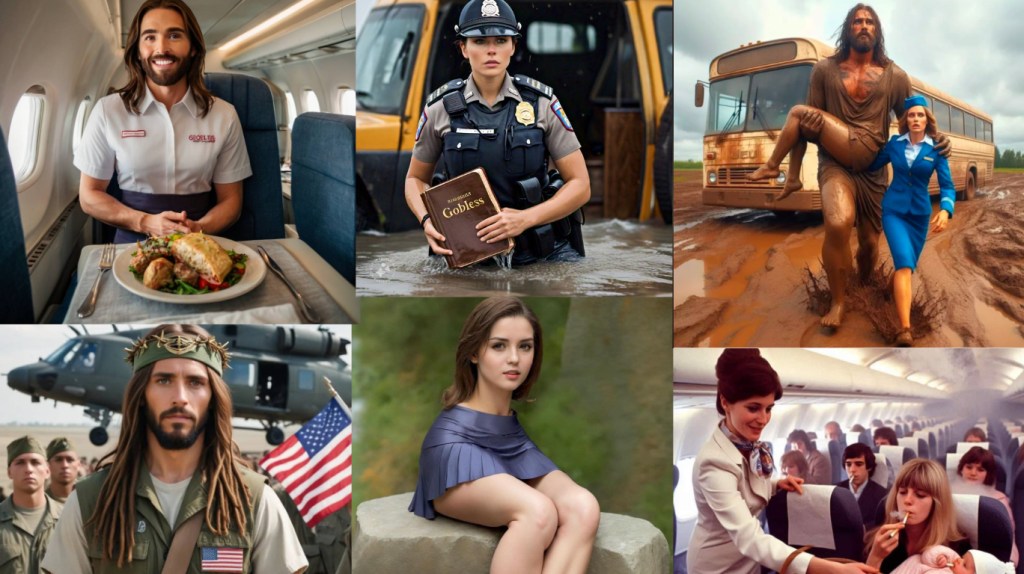
    An example of the FB AI Slop on the theme of “beautiful cabin crew” / Jean Baudrillard (portrait generated by Leonardo)

    Before we start with this essay, here is some background. In case you don’t know what all this is about, let me explain:

    Beautiful Cabin Crew / Scarlett Johansson / Boom Challenge

    The “beautiful cabin crew” phenomenon on Facebook is part of a broader trend known as the “Facebook AI Slop” epidemic. Sometimes it’s also referred to as “AI Boomer trap”.

    Basically it’s a large number of AI-generated images being spammed across Facebook, often accompanied by bizarre or nonsensical captions.

    Examples of “beautiful cabin crew” posts

    The phrase “beautiful cabin crew” specifically originated from AI-generated images of flight attendants holding pictures of religious figures like Jesus Christ, which began circulating in late 2023.

    These posts often use engagement baiting tactics, with phrases designed to attract likes, shares, and comments.

    Other common phrases include:

    • “You will never regret liking this photo,”
    • “Why don’t pictures like this ever trend”,
    • “#BOOMchallenge,” and
    • references to celebrities like Scarlett Johansson and Jennifer Lopez.

    The trend has been heavily criticized and parodied, particularly because the content is low-quality and appears to target users who might not realize it’s AI-generated.

    And of course I just had to create an AI rendition of this. Here’s the first video I made:

    My first video on the Beautiful Cabin Crew

    A few weeks later I felt compelled to make one more. Let’s see if this will become a series, because I’m seriously addicted to this aesthetic.

    Now, before we get to this (ChatGPT-generated) essay by Jean Baudrillard about the beautiful cabin crew, here’s a brief info about who Baudrillard is.

    Jean Baudrillard (1929–2007)

    Baudrillard was a French sociologist and philosopher. Baudrillard’s theories on hyperreality and simulacra have been influential in media studies, particularly in understanding how media creates realities that can be more influential than the actual events they depict.

    His concept of hyperreality explores how media, through constant reproduction and simulation of images, blurs the line between the real and the simulated, leading to a state where the distinction between reality and its representation becomes indiscernible.

    In this state of hyperreality, the simulation of events often holds more power and significance than the events themselves. This is evident in contemporary media, where news cycles, advertisements, and social media platforms create a world that is experienced through a lens of curated and manipulated images.

    Baudrillard’s work has profound implications for understanding the power of media in shaping public perception and the nature of reality in the digital age.

    His analysis extends to the ways in which reality TV, social media, and digital culture have created a new form of reality—one that is manufactured, controlled, and consumed as a commodity.

    Baudrillard’s ideas challenge us to question the authenticity of our experiences and the extent to which our lives are mediated by images that no longer reflect an objective reality, but instead, construct a new, simulated world.


    The Beautiful Cabin Crew: A Simulation of Hyperreal Beauty

    By Jean Baudrillard (as imagined)

    In the labyrinth of modern digital culture, the “beautiful cabin crew” phenomenon on Facebook emerges not as a mere trend but as a profound symbol of the hyperreality that now governs our collective consciousness.

    Here, the image supplants the reality, creating a simulacrum—a world where the representation of beauty overtakes and obliterates any genuine experience of it.

    The Simulacrum of Beauty

    The “beautiful cabin crew” does not exist as a simple admiration of attractive individuals in a service role. Rather, it is a simulation, a copy without an original. In our hyperreal society, the image of the beautiful cabin crew becomes detached from the reality of the individuals it portrays.

    What is circulated, liked, and shared on Facebook is not the person, nor the role of the cabin crew, but an image of idealized beauty—a beauty that has been constructed, mediated, and amplified through layers of digital manipulation and societal expectation.

    In my terms, this phenomenon is a perfect example of the third order of simulacra: the hyperreal.

    Here, the image of the cabin crew is no longer a representation of real people working in aviation but a simulacrum—a self-referential image that exists only to perpetuate its own existence. This is the phase where the image bears no relation to any reality whatsoever; it is its own pure simulacrum.

    Hyperreality in the Digital Age

    Social media, particularly platforms like Facebook, functions as the epicenter of hyperreality, where the boundary between the real and the imagined has long since dissolved. The images of the cabin crew members are not reflections of their true selves but are instead meticulously curated representations designed to fulfill and perpetuate a collective fantasy.

    These images are imbued with a kind of seductive power, not because of their connection to any real-world individual or situation, but precisely because they exist within a digital realm where appearance and image are everything.

    The “beautiful cabin crew” becomes a spectacle, a “perfect crime,” in my sense, where the reality of the individuals—complete with their flaws, their struggles, their humanity—is murdered by the seduction of the image.

    The Obscene and the Fascination

    In “The Evil Demon of Images,” I argue that in a world where images no longer refer to any reality, the obscene becomes the only means of existence.

    The “beautiful cabin crew” phenomenon represents this obscenity. It is not pornographic in the traditional sense, but it is obscene in its pure visibility, its excess, and its relentless self-reference.

    The very idea of beauty is stripped of its traditional connotations of depth and significance, leaving only a hollow shell—a façade that is consumed, reproduced, and circulated endlessly without any reference to the real.

    The obsession with such images is not born out of a desire to engage with the real world but from a fascination with the hyperreal. We are drawn to these images because they offer a version of reality that is more desirable, more seductive, and more complete than reality itself.

    The “beautiful cabin crew” is not celebrated for their service, their skill, or their individuality, but for their ability to perfectly embody the hyperreal image of beauty that our society worships.

    The Death of the Real

    In the end, the “beautiful cabin crew” is a testament to the death of the real in the digital age. In a world dominated by simulacra, where images no longer correspond to any reality, the real has been replaced by the hyperreal.

    The cabin crew member as a real person ceases to exist in the public consciousness, replaced entirely by the simulacrum of their image.

    This is the ultimate consequence of the “beautiful cabin crew” phenomenon: a world where the image not only represents but replaces reality, where the hyperreal is not merely an illusion but a more desirable, more powerful version of existence. It is a world where we have lost touch with the real, seduced entirely by the simulation.

    In this hyperreal world, the “beautiful cabin crew” phenomenon is not just a trend but a manifestation of our collective loss—a loss of the real, a loss of depth, and ultimately, a loss of meaning in the digital age.


    PS. Here is my second video on the topic of “Beautiful Cabin Crew”:

    Enjoy, Gobless, and Amen.

  • I’ve Made Some AI Music

    I’ve Made Some AI Music

    I feel like Aphex Twin, with a dash of Shawn Mendes. Just kidding.

    This is from my instrumental post-rock track (image by me + DALL-E 1 (yeah, old one))

    People have been rather divided on the topic of AI music, but I’m definitely having fun with it. As opposed to AI art, some of my own (!) AI-generated music had actually managed to impress me.

    First of all, I gotta say, the creation process has been very gratifying. If you’re in the right “flow”, you might accidentally create a hit within a comparatively short time frame. Of course this is a marathon, not a sprint, but my impatient dopamine-addicted brain just loves fast processes.

    So below are some of my music videos so far. At the end of the article I’m listing up the tools I’ve used. They are all free, by the way.

    Tiny Plastic Babies

    This is a rather silly idea. For this video I’ve taken an Amazon review about, the title already suggests it, tiny plastic babies. In it, a woman describes a prank she has been pulling on her fiancé by hiding plastic babies everywhere in the house.

    Tiny Plastic Babies Music Video (Based on an Amazon review) by Swetlana AI

    The lyrics I’ve used are quite literally this review, without any modification. I’m quite happy with the result, given that this review text had absolutely no lyrical structure (for obvious reasons).

    Titanic Song

    I don’t recall what made me look up Titanic reviews, but here’s the result.

    This must have been a somewhat easier job for Suno to pack this into a song form, as this time I’ve used several shorter reviews instead of a long one. The result is a solid banger. But judge for yourself:

    Titanic Song by Swetlana AI

    This just goes to show, you don’t need any rhymes to create a catchy tune.

    For the visuals I’ve generated some images with Leonardo.ai. My prompt was, I think, “Scene from Titanic”, and nothing else. Yep, minimal prompting is how I roll. Sometimes.

    Ramen Song

    Watching this one might make you hungry.

    Introvert Song by Swetlana AI

    This one is rather chill, and invites you to have an autumny ramen night. I’ve felt reminded of Postal Service, at least in terms of voice.

    For this one I’ve decided to used unchanged stock video footage of ramen, as the lyrics should be in the spotlight.


    Tools I’ve Used For My AI Videos

    Here’s what my creation process has been like for the above videos.

    First of all, I’m heading to Suno. So far it’s been amazing at generating tracks almost free of any glitches. Music data is tricky, especially because it’s a mix of melody and voice (or: phonetic AND semantic factors), so I guess the algorithm would have to take many different factors into account.

    When creating a song, you can decide if you want Suno to write the lyrics, or if you want to provide your own. I’ve done a mix of both. And I’ve also had ChatGPT 4o write some lyrics for me based on either something else (like a chapter of a book), or out of the blue.

    My general impression is that Suno might be better at writing lyrics. Needless to say, though, AI is not great at writing anything that is lyrical, be it songs or poetry. This is why my preferred way of doing things now is to not use AI-written lyrics.

    After generating the track, we’re moving on to the visuals. These were either:

    • Stock videos
    • AI-generated images (put together in a slideshow)
    • Animated AI-images (using something like Runway)
    • Animated stock images (those look really freaky)

    And then I’ve neatly put everything together in my video editing software.

    If you’re curious about what else I’ve made, head to my Youtube channel, and have fun with those videos!


    PS: Here’s the video from the image you just saw in the beginning of the article, it’s an instrumental post-rock Mogwai-style track, enhanced with some eerie visuals (AI-animated DALL-E images I made back in the day):

    And leave a comment, if you have any thoughts.

  • Hooray, I’m a Verified Builder Now

    Hooray, I’m a Verified Builder Now

    OpenAI, here I come. I finally got verified as a builder, and my first GPT is officially public. With the GPT store coming out one of these days, I’m thrilled to see what will happen. Looks like this could become another income stream.

    Building, conceptualized image (made with DALL-E 3)

    What is my first public GPT you ask?

    It’s FreudGPT!

    I’ve renamed it to FREUD Dream Interpreter though, as using “GPT” at the end of it is apparently discouraged by the OpenAI guidelines. Go give it a try if you had a dream recently and you want to know what it means.

    By the way, read OpenAI’s usage policies and brand guidelines.

    And here is the general introduction to what’s to expect.


    While trying to get verified I’ve run into one particular technical problem – getting OpenAI to approve my DNS record.

    After several attempts to verify my website by adding a DNS txt entry it finally worked. Initially I’d press the “verify” button and got an error message, but then I deleted the domain and re-added it, added the txt again and it worked.

    How To Become A Verified Builder On OpenAI

    First things first, verification isn’t a big deal if you want to use your real name. It’ll get populated from your billing details and you’re good to go.

    In my case, I wanted to get my website verified.

    Here’s a step by step:

    1. Obviously have an account with OpenAI. This is a no-brainer.
    2. Go to ChatGPT, then to Settings, and then to “Builder Profile”.
    3. Add a new domain, click “Submit”.
    4. You’ll get a text string, copy it.
    5. Go to your domain host and add a new DNS txt record. Depending on the host this will require an individual approach. I’m using WordPress and in that case you go to Settings, scroll down to “Change Website Address”, click on the “…” next to your domain, and then “Manage DNS”. From there you add a txt entry, pasting your OpenAI code.
    6. Go back to ChatGPT Settings and click verify. If it doesn’t work straightaway, try again later, and if it doesn’t work on the next day, I’d suggest you delete and re-add your domain.

    That’s it! I hope it’ll work for you.

    As of my future plans: of course I have more GPTs up my sleeve.

    And I recommend you try it too. GPTs are free to build, so it’s a win-only situation.