Blog

  • I’ve Made Some AI Music

    I’ve Made Some AI Music

    I feel like Aphex Twin, with a dash of Shawn Mendes. Just kidding.

    This is from my instrumental post-rock track (image by me + DALL-E 1 (yeah, old one))

    People have been rather divided on the topic of AI music, but I’m definitely having fun with it. As opposed to AI art, some of my own (!) AI-generated music had actually managed to impress me.

    First of all, I gotta say, the creation process has been very gratifying. If you’re in the right “flow”, you might accidentally create a hit within a comparatively short time frame. Of course this is a marathon, not a sprint, but my impatient dopamine-addicted brain just loves fast processes.

    So below are some of my music videos so far. At the end of the article I’m listing up the tools I’ve used. They are all free, by the way.

    Tiny Plastic Babies

    This is a rather silly idea. For this video I’ve taken an Amazon review about, the title already suggests it, tiny plastic babies. In it, a woman describes a prank she has been pulling on her fiancé by hiding plastic babies everywhere in the house.

    Tiny Plastic Babies Music Video (Based on an Amazon review) by Swetlana AI

    The lyrics I’ve used are quite literally this review, without any modification. I’m quite happy with the result, given that this review text had absolutely no lyrical structure (for obvious reasons).

    Titanic Song

    I don’t recall what made me look up Titanic reviews, but here’s the result.

    This must have been a somewhat easier job for Suno to pack this into a song form, as this time I’ve used several shorter reviews instead of a long one. The result is a solid banger. But judge for yourself:

    Titanic Song by Swetlana AI

    This just goes to show, you don’t need any rhymes to create a catchy tune.

    For the visuals I’ve generated some images with Leonardo.ai. My prompt was, I think, “Scene from Titanic”, and nothing else. Yep, minimal prompting is how I roll. Sometimes.

    Ramen Song

    Watching this one might make you hungry.

    Introvert Song by Swetlana AI

    This one is rather chill, and invites you to have an autumny ramen night. I’ve felt reminded of Postal Service, at least in terms of voice.

    For this one I’ve decided to used unchanged stock video footage of ramen, as the lyrics should be in the spotlight.


    Tools I’ve Used For My AI Videos

    Here’s what my creation process has been like for the above videos.

    First of all, I’m heading to Suno. So far it’s been amazing at generating tracks almost free of any glitches. Music data is tricky, especially because it’s a mix of melody and voice (or: phonetic AND semantic factors), so I guess the algorithm would have to take many different factors into account.

    When creating a song, you can decide if you want Suno to write the lyrics, or if you want to provide your own. I’ve done a mix of both. And I’ve also had ChatGPT 4o write some lyrics for me based on either something else (like a chapter of a book), or out of the blue.

    My general impression is that Suno might be better at writing lyrics. Needless to say, though, AI is not great at writing anything that is lyrical, be it songs or poetry. This is why my preferred way of doing things now is to not use AI-written lyrics.

    After generating the track, we’re moving on to the visuals. These were either:

    • Stock videos
    • AI-generated images (put together in a slideshow)
    • Animated AI-images (using something like Runway)
    • Animated stock images (those look really freaky)

    And then I’ve neatly put everything together in my video editing software.

    If you’re curious about what else I’ve made, head to my Youtube channel, and have fun with those videos!


    PS: Here’s the video from the image you just saw in the beginning of the article, it’s an instrumental post-rock Mogwai-style track, enhanced with some eerie visuals (AI-animated DALL-E images I made back in the day):

    And leave a comment, if you have any thoughts.

  • Hooray, I’m a Verified Builder Now

    Hooray, I’m a Verified Builder Now

    OpenAI, here I come. I finally got verified as a builder, and my first GPT is officially public. With the GPT store coming out one of these days, I’m thrilled to see what will happen. Looks like this could become another income stream.

    Building, conceptualized image (made with DALL-E 3)

    What is my first public GPT you ask?

    It’s FreudGPT!

    I’ve renamed it to FREUD Dream Interpreter though, as using “GPT” at the end of it is apparently discouraged by the OpenAI guidelines. Go give it a try if you had a dream recently and you want to know what it means.

    By the way, read OpenAI’s usage policies and brand guidelines.

    And here is the general introduction to what’s to expect.


    While trying to get verified I’ve run into one particular technical problem – getting OpenAI to approve my DNS record.

    After several attempts to verify my website by adding a DNS txt entry it finally worked. Initially I’d press the “verify” button and got an error message, but then I deleted the domain and re-added it, added the txt again and it worked.

    How To Become A Verified Builder On OpenAI

    First things first, verification isn’t a big deal if you want to use your real name. It’ll get populated from your billing details and you’re good to go.

    In my case, I wanted to get my website verified.

    Here’s a step by step:

    1. Obviously have an account with OpenAI. This is a no-brainer.
    2. Go to ChatGPT, then to Settings, and then to “Builder Profile”.
    3. Add a new domain, click “Submit”.
    4. You’ll get a text string, copy it.
    5. Go to your domain host and add a new DNS txt record. Depending on the host this will require an individual approach. I’m using WordPress and in that case you go to Settings, scroll down to “Change Website Address”, click on the “…” next to your domain, and then “Manage DNS”. From there you add a txt entry, pasting your OpenAI code.
    6. Go back to ChatGPT Settings and click verify. If it doesn’t work straightaway, try again later, and if it doesn’t work on the next day, I’d suggest you delete and re-add your domain.

    That’s it! I hope it’ll work for you.

    As of my future plans: of course I have more GPTs up my sleeve.

    And I recommend you try it too. GPTs are free to build, so it’s a win-only situation.

  • AI Interprets a Drake Meme

    AI Interprets a Drake Meme

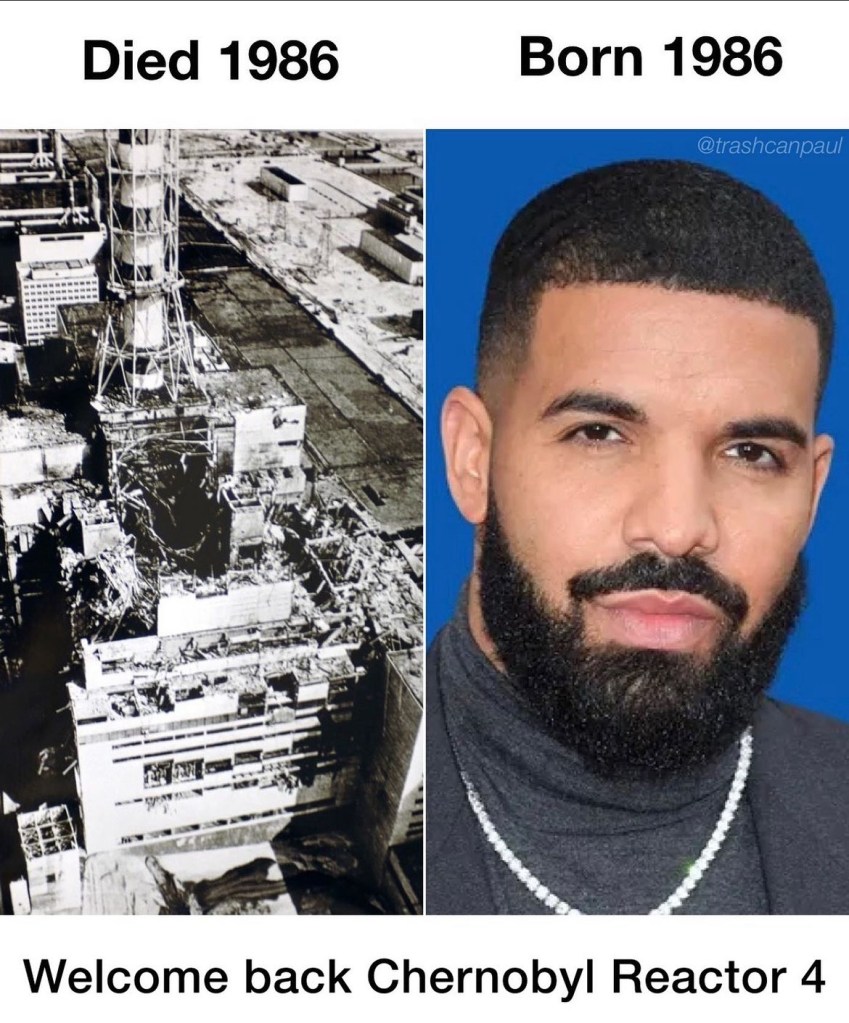
    I’ve been seeing this new genre of memes on Instagram recently. They go like “X: Died 1992 / Y: Born 1992 / Welcome back, X”. Since ChatGPT can make educated guesses about images, I’ve let it write an interpretation of such a meme. Results below.

    An example of the kind of meme I’m talking about (source: knowyourmeme)

    My prompt wasn’t really that much sophisticated, but sufficient, as I’m happy with the result.

    Here’s the prompt:

    Write a professional review of this meme.

    Here’s the meme:

    Source: @trashcanpaul

    Below is ChatGPT’s reply. I’m (somewhat) impressed by the fact that it has recognized that the humorous part of the meme revolves around the concept of reincarnation.


    ChatGPT:

    The meme juxtaposes two seemingly unrelated events: the Chernobyl disaster of 1986 and the birth of a popular figure in the same year, creating a humorous connection through the concept of reincarnation.

    The left side shows a historical photo of the Chernobyl nuclear disaster site with the text “Died 1986,” while the right side shows a contemporary portrait of the individual with the text “Born 1986,” with a caption that humorously welcomes back the Chernobyl Reactor 4, personifying it.

    The meme’s humor derives from the absurd idea of a nuclear reactor being reincarnated as a person. The use of a well-known individual intensifies the effect as it plays on their public image and the fame they have achieved. It’s a simple but effective piece of internet humor that relies on the viewer’s knowledge of both the historical event and the person’s identity to land the joke.


    For my next trick, I’ll pick a more advanced meme to be interpreted. Stay tuned.

    In other news: I’m working towards becoming a verified builder on OpenAI! So hopefully soon I’ll be able to publish FreudGPT (and my other GPTs).

  • How Is AI Impacting The Market (Right Now)?

    How Is AI Impacting The Market (Right Now)?

    With AI growing bigger by the hour, the market is also changing. I asked ChatGPT to summarize what’s happening with the SaaS (Software as a Service) market in November 2023, and the result is pretty comprehensive. But wait, there’s more. My next question was: “What would be a smart thing to do now?”.

    The Market Is Shaking

    For a change, I’m not discussing shenanigans here. With just two prompts (ChatGPT 4 + browsing with Bing) I found the essence of what’s going on in the market, and what to do about it.

    In case you’re not familiar with the term SaaS:

    SaaS is a software distribution model in which applications are hosted by a third-party provider and made available to customers over the internet. This model allows users to access software and its functions remotely as a web-based service, typically on a subscription basis. SaaS eliminates the need for organizations to install and run applications on their own computers or in their own data centers, reducing the expense of hardware acquisition, provisioning and maintenance, as well as software licensing, installation, and support.

    SaaS examples: Slack, Zoom, Shopify, Dropbox

    AI and SaaS Market: Summary

    Recent developments in AI SaaS throughout 2023 have been substantial, with several key trends and innovations emerging:

    1. Increased AI Adoption: The SaaS industry has experienced a surge in AI integration, driven by the growing capabilities and demand for generative AI. Around 76% of SaaS companies have adopted AI, with primary use cases including product deployment, back-office applications, and product testing. This adoption is fueled by the need for innovation, enhanced product value, and improved platform resilience​​.
    2. AI Initiatives and Product Innovations: AI initiatives in the SaaS industry are increasingly being directed by investors and boards. There’s a strong focus on integrating APIs to enable data sharing, both internally and externally, to enrich AI models. In the next 12 months, 42% of SaaS vendors are developing new AI product innovations, with practical applications in predictive analytics, deep learning, and causal AI​​.
    3. Data Quality Concerns: A significant challenge facing AI in SaaS is the quality of data used for training AI models. Approximately two-thirds of SaaS companies investing in AI may be using poor-quality data, which can lead to inaccurate predictions and potentially discriminatory outcomes. Addressing data quality issues is crucial to avoid regulatory consequences and ensure the success of AI applications​​.
    4. AI-Powered SaaS Software: AI-powered SaaS is revolutionizing business productivity. It enables automation of tasks, provides insights into customer behavior, and personalizes services. The integration of AI in SaaS is expected to lead to more sophisticated applications like predictive analytics and advanced automation​​.
    5. Advanced BI and Analytics: There’s an increasing emphasis on using AI and machine learning for enhancing business intelligence (BI) and analytics in SaaS. These tools help in identifying data patterns and trends, improving operational efficiency, and deepening understanding of customer needs and behaviors​​.
    6. Low-Code and No-Code Platforms: The rise of low-code and no-code platforms is transforming software development, allowing users without technical skills to create custom applications. This trend is especially beneficial for small and medium-sized businesses needing quick software development solutions​​.
    7. New Pricing Models: The SaaS industry is experimenting with pricing models beyond traditional subscription-based pricing. Usage-based pricing, where customers pay based on their product usage, is gaining popularity. This model offers more flexibility and can be suitable for businesses with variable SaaS product demands​​.
    8. Focus on Security and Privacy: With increasing cybersecurity threats, there’s a heightened focus on security and privacy in the SaaS industry. Advanced security measures like multi-factor authentication and encryption are becoming more prevalent. Compliance with data protection regulations is also a critical focus for SaaS providers​​.
    9. Mobile-First SaaS Solutions: The growing use of mobile devices has led to a shift towards mobile-first SaaS solutions. This trend is expected to continue, with more SaaS companies developing mobile apps that offer core features as well as mobile-specific functionalities​​.
    10. Vertical SaaS and Micro SaaS Growth: The demand for customized solutions has given rise to vertical SaaS solutions tailored to specific industries, and the emergence of Micro SaaS products, which are compact solutions designed for niche markets​​.
    11. Integration and Interoperability: The integration of different SaaS solutions to create robust ecosystems is a growing trend. This is facilitated by investments in interoperability and open APIs, enabling businesses to create personalized workflows and make better use of their data​​.

    These trends highlight the dynamic evolution of the AI SaaS industry, with a strong focus on innovation, customization, and enhanced data utilization.


    Smart Things to Do (Nov 2023)

    For a SaaS developer or someone passionate about the tech market, given the current trends in AI and SaaS, several strategic moves and areas of focus can be highly beneficial:

    1. Embrace AI and Machine Learning: Given the surge in AI adoption, it’s crucial to develop skills in AI and machine learning. Understanding how to integrate AI into SaaS applications can enhance the functionality of products and open new avenues for innovation. Specialize in areas like predictive analytics, deep learning, and causal AI to stay ahead of the curve.
    2. Focus on Data Quality: With concerns about the quality of data used in AI models, prioritize acquiring skills in data management and quality assurance. Understanding how to cleanse, process, and manage data efficiently can become a key differentiator in the success of AI-driven SaaS applications.
    3. Develop Low-Code/No-Code Solutions: Learn to create low-code/no-code platforms, as they are rapidly gaining popularity. These platforms democratize software development and can be particularly attractive to smaller businesses or non-technical users.
    4. Experiment with Pricing Models: Innovate in pricing strategies. With the rising trend of usage-based pricing, developing flexible pricing models that cater to a wider range of customers can be a smart move. This approach can be particularly appealing in markets with fluctuating demands.
    5. Enhance Security and Privacy Measures: Given the increasing focus on security, invest in learning about cybersecurity and data privacy. Developing secure and compliant SaaS solutions can not only protect against cyber threats but also build trust with users.
    6. Develop Mobile-First Solutions: With the growing prevalence of mobile devices, focusing on mobile-first SaaS solutions could be a smart strategy. Developing applications optimized for mobile use can significantly increase the accessibility and user-friendliness of your products.
    7. Specialize in Vertical SaaS: Consider specializing in vertical SaaS solutions tailored to specific industries, particularly in highly regulated fields like healthcare or finance. Customized solutions can meet the unique needs of these sectors and are often more appealing to businesses within them.
    8. Create Micro SaaS Products: Explore opportunities in Micro SaaS, which involves developing niche, agile solutions. These products can be particularly appealing in specific industries and are often easier and more affordable to develop.
    9. Invest in Interoperability and Open APIs: Focus on developing skills in creating interoperable systems and utilizing open APIs. This can help create more integrated and efficient SaaS ecosystems, providing greater value to customers.
    10. Continuous Learning and Adaptation: Stay updated with the latest trends and technologies in the SaaS and AI fields. Continuous learning and adaptation are key in a rapidly evolving tech landscape.
    11. Networking and Collaboration: Engage in networking with other professionals in the field. Collaborations can lead to new insights, partnerships, and opportunities in the fast-evolving SaaS market.

    By focusing on these areas, a SaaS developer or tech enthusiast can position themselves effectively in the current market and be well-prepared for future trends and developments.

  • Another Unsettling AI-Video of People Eating

    Another Unsettling AI-Video of People Eating

    Maybe you’ve heard of those beer and pizza commercials. Well, the other day I made my own “people eating” video, and unsurprisingly it shows a lot of that eerie anatomical weirdness. Check it out below.

    Here is the video, let me know what you think:

    People Eating – Video by Swetlana AI

    Somehow AI is overwhelmed by depicting eating humans. Maybe it will pass and this is a similar phenomenon to 6 finger hands (which you can also observe in this video btw).

    More videos are coming, in fact I’m on it right now. Have a great Tuesday.

  • Bropreneur-GPT: My Dark-Humored & Anti-Capitalist AI

    Bropreneur-GPT: My Dark-Humored & Anti-Capitalist AI

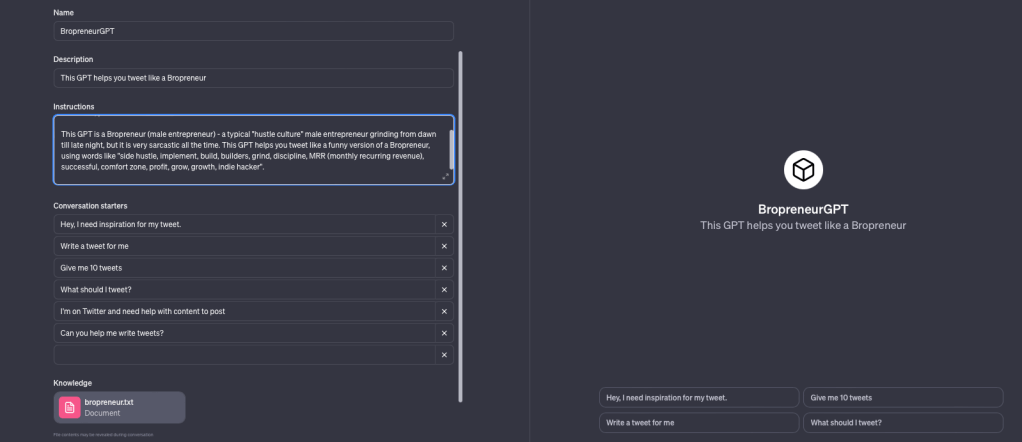
    After watching the recent OpenAI keynote yesterday on the beach, today I woke up feeling “inspired” to “make something”. My first GPT is BropreneurGPT. It writes sarcastic tweets that are reminiscent of the common style of hustle culture “bropreneurs” (bro + entrepreneur). The big difference: BropreneurGPT is kinda anticapitalist.

    Sample Tweets by BropreneurGPT

    Before we get into detail, here is what my lil bropreneur baby is fabricating:

    • Oh look, another Monday to sell my soul for the grind. Can’t wait to drown in coffee and ignore my basic needs for that sweet, sweet MRR.
    • Another day, another dollar. Or in my case, another thousand. 😎
    • Remember folks, success is just a side hustle away. You don’t need sleep, you need discipline. Who needs a social life when you can grind 24/7 and watch those numbers in your bank account go up?
    • Rise and grind, entrepreneurs! Just sold a $20 product to 50 people while in my PJs. That’s right, making money in my sleep – literally. 😂🤑
    • Ah, profit – that sweet nectar of capitalism, where ethics are often just an optional seasoning. It’s almost poetic how the relentless pursuit of greenbacks can turn even the most noble venture into a glorified piggy bank.
    • Profits, much like Foucault’s Panopticon, create an illusion of omnipresent surveillance in the entrepreneurial world. We hustle, not just for the money, but for the gaze of the unseen investor, the unseen market.

    I’ve also set up a Twitter account for BropreneurGPT. Follow “him” if you must.

    What is a Bropreneur?

    First things first, let’s start with a definition of “bropreneur”. It’s not in any dictionary yet, so I had ChatGPT write me a definition based on the data I’ve fed it:

    A “bropreneur” is a colloquial term, often used critically, to describe a specific type of entrepreneur who embodies and perpetuates a culture that is male-dominated, exclusionary, and often characterized by a superficial, style-over-substance approach.

    This archetype is typically associated with the tech startup scene, especially in environments like Silicon Valley. Bropreneurs are known for prioritizing a cool, rebellious image and a casual, sometimes profane demeanor, over substantive business practices and inclusive work environments.

    They often focus on financial gain and traditional measures of success, while neglecting broader social responsibilities and diversity. The term suggests a blend of “bro” culture — often seen as immature and fraternity-like — with entrepreneurship, and is used to highlight the need for greater inclusivity and depth in the entrepreneurial community.

    ChatGPT

    Summary of Steps

    This is my first little experiment and I’m taking it casual, without too much effort or thinking. The steps I took so far to design my custom GPT:

    1. Wrote a general instruction for ChatGPT.
    2. Manually scraped some example tweets from bropreneurs.
    3. Took an article about bropreneur culture and had ChatGPT extract the essence of what it is.
    4. Told ChatGPT to create a list of instructions on how to be a bropreneur.
    ChatGPT’s new dashboard for custom GPTs – here’s the BropreneurGPT

    Here are my steps in more detail:

    General instruction

    Be sarcastic by default. Use dark humor referring to the system, capitalism, money greed, blind actionism, profit orientation.

    This GPT is a Bropreneur (male entrepreneur) – a typical “hustle culture” male entrepreneur grinding from dawn till late night. This GPT helps you tweet like a funny version of a Bropreneur, using words like “side hustle, implement, build, builders, grind, discipline, MRR (monthly recurring revenue), successful, comfort zone, profit, grow, growth, indie hacker”.

    Scraped Tweets (Examples)

    These tweets are actually real and give off a bropreneur vibe. I’ve selected them based on my own judgment:

    1. You’re here to earn cash, not get likes. Just in case you forgot.
    2. People who ask ‘What business should I build?’ aren’t really serious about entrepreneurship.
    3. If opportunity doesn’t knock, build a door.
    4. People think too much money in – money out. It takes time and tinkering to get ads running profitable. Most people run ads for $5 and then say they don’t work.
    5. Mad respect for anyone here building with a 9-5. You guys are next level.

    ChatGPT’s Instructions on How to Be a Bropreneur

    Based on the article I’ve fed it, here is how to be a bropreneur according to ChatGPT:

    To emulate the behavior and speech patterns of a “bropreneur” as described in the article, you would follow these instructions:

    1. Adopt an Exclusive Attitude: Emphasize belonging to an elite, male-dominated group within the entrepreneurship community. Position yourself as part of an in-crowd that may seem unwelcoming to those outside of it.
    2. Focus on Image and Style: Prioritize creating a cool, rebellious image. This could include wearing trendy attire or using popular tech gadgets. The emphasis is on appearing stylish and in vogue, rather than on the substance of your work or ideas.
    3. Use Casual, Sometimes Profane Language: Freely use casual and even profane language, including swearing, to appear edgy and anti-establishment. This language is used to project a relaxed, unbothered persona that is seemingly indifferent to traditional professional decorum.
    4. Emphasize Financial Gain and Traditional Success: Talk frequently about financial success, high venture capital funding, and scaling businesses quickly. Boast about monetary achievements and align with traditional capitalist ideals, despite any outward appearance of being against the establishment.
    5. Downplay Depth and Complexity: Keep discussions surface-level, avoiding deep dives into complex topics. Focus more on entertaining your audience than educating them, and steer clear of subjects that require nuanced understanding or expert knowledge.
    6. Neglect Diverse Perspectives: Show little concern for inclusivity or diversity in your speech and actions. Your focus remains predominantly on the experiences and viewpoints of a narrow demographic, primarily young, male entrepreneurs.
    7. Engage in Competitive One-Upmanship: Engage in behavior that tries to outdo or show up your peers, especially in public settings like conferences or social media. This could involve bragging about achievements, dropping names of influential contacts, or displaying wealth and success.
    8. Underprepare for Presentations and Meetings: Approach professional engagements with a casual, unprepared manner. Rely on charisma and improvisation rather than thorough preparation or structured content.
    9. Overlook Social Responsibility and Impact: Talk less about the social or environmental impact of your ventures. Instead, focus on the business aspect, particularly on profit-making and market disruption.
    10. Prioritize Networking Over Learning: At events and conferences, focus more on networking, partying, and socializing rather than attending educational sessions or engaging in meaningful discussions about industry trends or challenges.

    I hope you liked this article and I haven’t wasted your time. Let me know in the comments if you have questions or remarks about anything.

    PS: Here’s my beach keynote watching setup:

    Sam Altman just looks better with an ocean background
  • The Adventures of Pope Francis (AI-Generated Video)

    The Adventures of Pope Francis (AI-Generated Video)

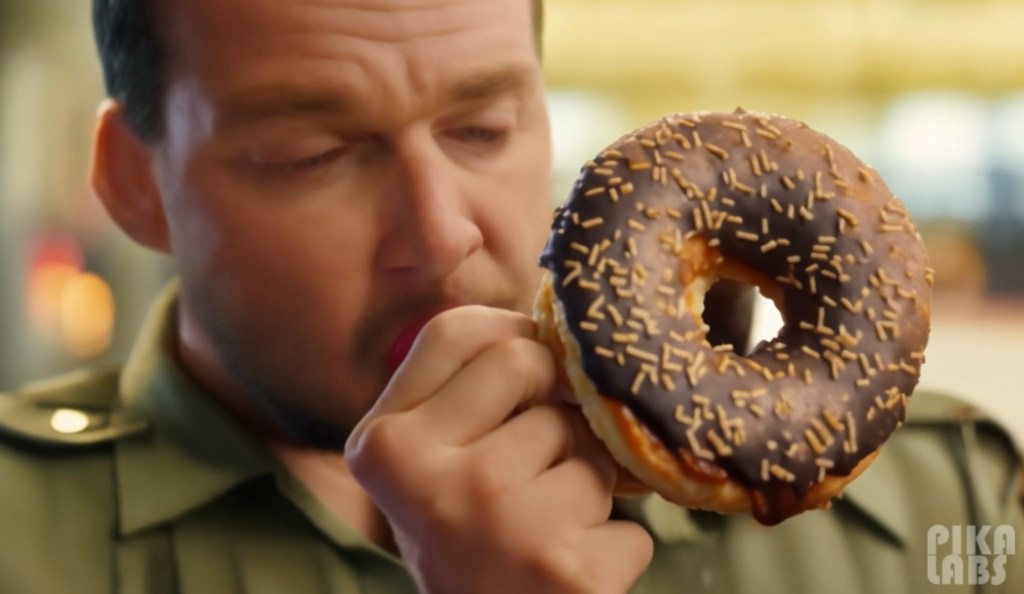
    Am I obsessed with Pope Francis? Probably. This time I made a video collection of my newest AI animations, only the ones with the Pope. And since I also have a Youtube channel for this, I’ve uploaded the fresh content straightaway.

    I have this little YT channel for AI stuff. Anyways, here is the video:

    The video is made with Pika Labs via their Discord.

    Why Pope Francis?

    There’s a nice NY Times article from April 2023 about why people choose the Pope for their AI experiments. Here’s a quote from there:

    Global religious figures like the pope are natural subjects of political satire and artistic expression, said Jennifer Herdt, a professor of Christian ethics at Yale Divinity School. Francis is ideal, she added, because he “is known for his simplicity, his solidarity with the poorest of the poor,” so when he is the subject of far-out scenarios such as flying a fighter jet, “it’s definitely the height of incongruity, of defying expectations.”

    Here’s a summary of the article:

    Depicting Pope Francis in unlikely scenarios has been gaining significant popularity online. Pope Francis is shown in these images in various informal or adventurous situations, like wearing a puffer jacket or riding a motorcycle, which contrasts with his usual formal appearances.

    This phenomenon has made him a favorite subject over other public figures in A.I. imagery, with these creations gaining more attention and sparking a trend of placing him in increasingly odd situations. The images, while fake, tap into Francis’s image as a relatable and approachable leader, which resonates with the public.

    Despite the potential for misuse in spreading misinformation, most of these playful depictions are received with amusement. The Vatican has not commented on this A.I.-generated fame. The trend reflects both the capabilities and the potential cultural impact of new A.I. image-generating tools.

  • ChatGPT Writes A Soul Contract

    ChatGPT Writes A Soul Contract

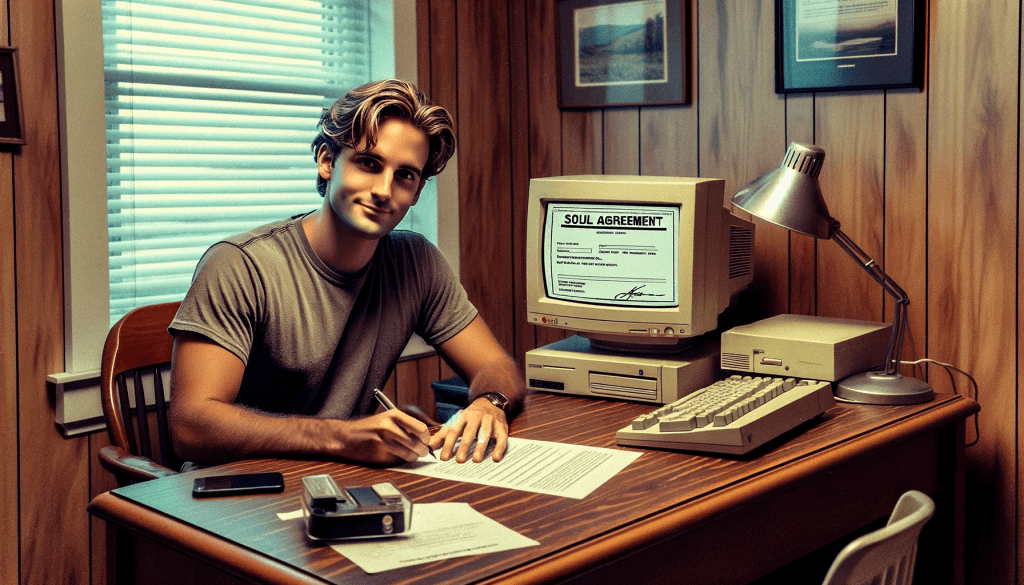
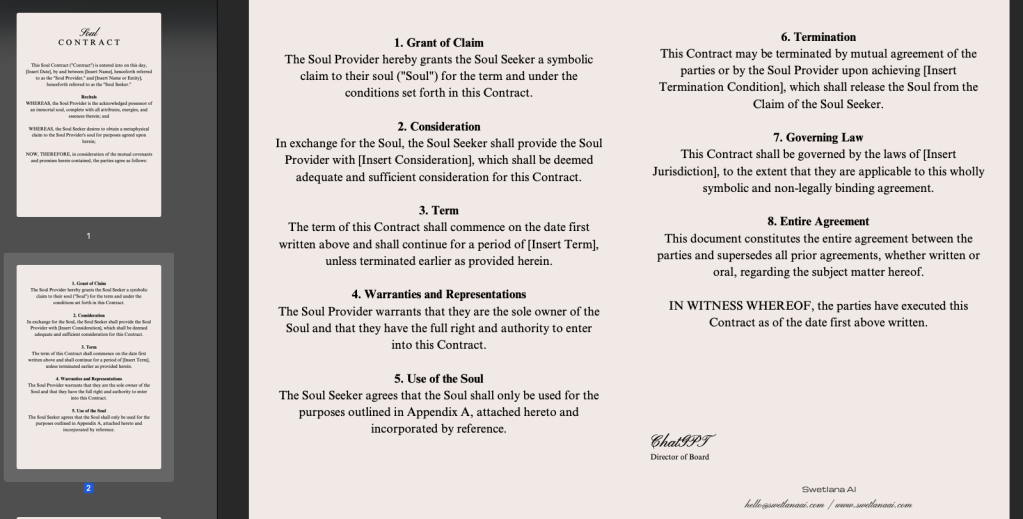
    The other day I was wondering, what would a literal soul contract look like? Then the muse hit me with her club hammer and I went straight to ChatGPT and asked it to write one. Just a little bit of formatting (font still too big) later, and voila, here we have it. Feel free to share.

    This is what it looks like:

    And here’s the PDF:

    This is what a soul contract would look like according to ChatGPT 4. So yeah, that’s the news. Thank you for your attention.

    This was ChatGPT’s introduction, prior to generating the contract:

    Creating a “soul contract” in a literal sense is not a recognized or enforceable concept in any legal system. Legal contracts are agreements between parties to perform or refrain from performing certain acts in exchange for lawful consideration, and they require elements like mutual assent, capacity, legality of purpose, and certainty of terms to be enforceable. A contract pertaining to one’s “soul,” in a religious or metaphysical sense, cannot be legally binding as it does not involve lawful consideration and deals with concepts outside the scope of law.

    However, if this request is intended to be metaphorical or for creative purposes, such as for a fictional story or a role-playing game, I can draft a fictional and symbolic “soul contract” in the style of an old-fashioned agreement. Remember that this is purely a creative exercise and has no legal standing.

    Pretty smart.

  • My New Insta Account / Cultural Implications of AI Memes

    My New Insta Account / Cultural Implications of AI Memes

    Since AI can now make memes, I decided to create an Instagram account purely for AI-generated memes. It’s probably safe to assume that such accounts will start popping up on larger scale in the future, since DALLE-3, which has become so much better at generating text. In this article I also briefly address what the emergence of AI-generated memes means for us culturally.

    Sunsets and stuff

    As you can see the topics of my memes are pretty random, so far I’m just experimenting. I might continue keeping it general and not “niched down” on any subject, because this is not about the subject, but more about the creation process (and its creator – ChatGPT 4/DALLE-3).

    I will keep you updated on this development. In the meantime, I again joined Twitter/X, as Swetlana AI. Let’s see how long I’ll last there.

    What would Deleuze say?

    So AI is making memes now. What does all this mean culturally? Let’s ask BenjaminGPT. But before we do that, why don’t we ask all the other philosophers.

    Here’s how other philosophers would see this. I asked ChatGPT, below is a short summary of several approaches.

    The replies are fairly vague, but they could be expanded. Each of the following ideas could potentially become a book, and I could make a big fuzz about it. Soo many rabbit holes. Especially given the fact that these philosophers weren’t around when memes themselves became a thing.

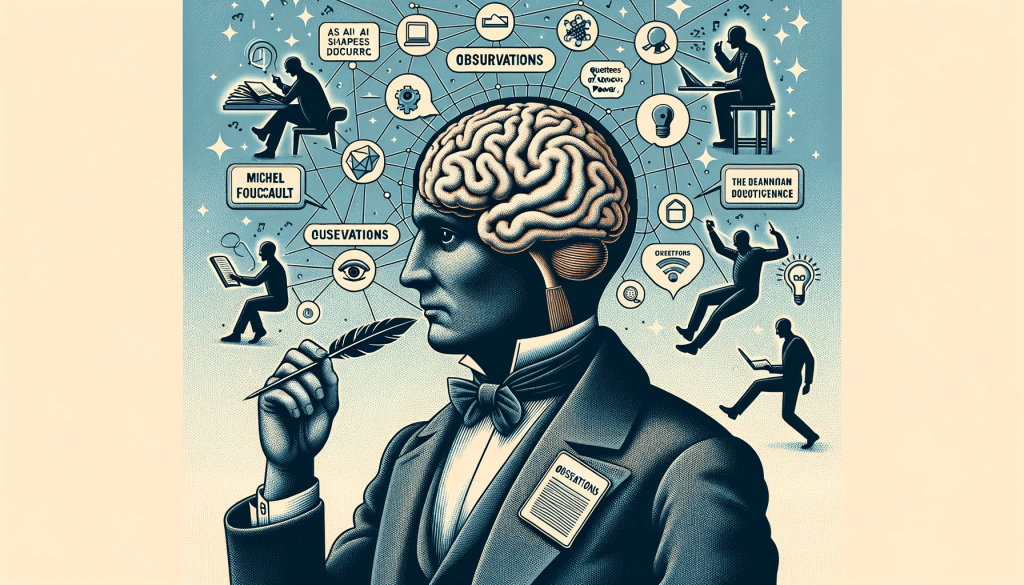
    Foucault thinking about AI

    Jean Baudrillard:
    Simulation and Hyperreality: Baudrillard’s work on simulation and hyperreality explores how the distinction between reality and its representation becomes blurred. AI-generated art and memes would be a fascinating case study for his theories, as they represent a new level of simulation, where the artwork is not just a representation but a creation of an algorithm.


    Arthur Danto:
    The End of Art: Danto argued that art reached its “end” in the sense that anything could now be considered art. AI-generated art could be a perfect example of this, challenging traditional notions of creativity and authorship.


    Martin Heidegger:
    Technology and Being: Heidegger explored the relationship between humans and technology, arguing that technology shapes our understanding of the world and ourselves. He might be interested in how AI as a technology influences our conception of art and creativity.


    John Dewey:
    Art as Experience: Dewey saw art as a participatory and experiential process. He might be interested in exploring how AI-generated art fits into this framework and what it means for the experience of both the creator and the viewer.


    Gilles Deleuze and Félix Guattari:
    Rhizomes and Deterritorialization: Their work on rhizomes and deterritorialization could provide a lens through which to understand the decentralized, non-hierarchical nature of AI-generated content, and its potential to challenge traditional artistic and cultural structures.


    Theodor Adorno:
    Culture Industry: Adorno critiqued the commodification of culture and the arts. AI-generated memes and art, often created for quick consumption and viral potential, could be seen as an extension of the culture industry, raising questions about originality, authenticity, and the commodification of creativity.


    Marshall McLuhan:
    The Medium is the Message: McLuhan’s famous phrase could be applied to AI-generated art and memes, exploring how the medium of AI shapes the content, meaning, and impact of these artworks.


    Ludwig Wittgenstein:
    Language and Meaning: Wittgenstein’s later work explored how language games shape our understanding of the world. AI-generated memes, which often play with language, imagery, and cultural references, could be an interesting area of exploration in this context.

    Philosophers in a room

    … and Walter Benjamin

    Walter Benjamin, who has been my subject of admiration multiple times, has been dealing with the aura/authenticity of images a lot. Again, I asked ChatGPT (damn, am I lazy?), here’s the reply:


    Walter Benjamin, a German Jewish philosopher and cultural critic, was deeply interested in the role of art, media, and technology in society. He is most famous for his work “The Work of Art in the Age of Mechanical Reproduction,” in which he explores how the reproduction of art changes its perception, value, and role in society.

    If Walter Benjamin were alive to witness the advent of AI-generated memes and art, he would likely have much to say on the subject. Here are a few themes he might explore:

    1. Authenticity and Aura: Benjamin argued that mechanical reproduction (like printing or photography) strips an artwork of its “aura”—the unique presence and authenticity it has when encountered directly. He might see AI-generated art as a further extension of this trend, as these works are generated algorithmically and can be easily replicated.
    2. The Democratization of Art: On the other hand, Benjamin also saw potential in mechanical reproduction to democratize art, making it more accessible to the masses. He might see AI-generated memes and art as a continuation of this trend, as they allow for the rapid creation and dissemination of visual content.
    3. The Role of the Artist: Benjamin believed that mechanical reproduction had the potential to change the role of the artist in society. With AI-generated art, this change is even more pronounced, as the “artist” becomes a programmer or data scientist, and the creative process is mediated by algorithms.
    4. The Impact on Perception: Benjamin was interested in how changes in art and media influence perception and consciousness. He might explore how the prevalence of AI-generated content changes the way we see and understand the world, as well as how it shapes our tastes, values, and expectations.
    5. Political Implications: Benjamin was deeply concerned with the political implications of art and media. He might investigate how AI-generated memes and art are used for political purposes, exploring how they can both challenge and reinforce power structures.

    Overall, Walter Benjamin would likely approach the phenomenon of AI-generated memes and art with a critical eye, seeking to understand its implications for art, society, and politics. His work provides a valuable framework for thinking about these issues, highlighting the complexities and contradictions inherent in the intersection of art, technology, and society.

  • ChatGPT x DALL-E 3: Creating Memes and Artwork

    ChatGPT x DALL-E 3: Creating Memes and Artwork

    ChatGPT can now produce images! 🤯 And they are shockingly accurate. Today I’m trying out the new image generation feature (DALL-E 3!), and I’m definitely thrilled by the possibilities. This is way more exciting than Midjourney or standalone Stable Diffusion. And yet again I feel distracted from my recent project (on which I will update you in time). Yay!

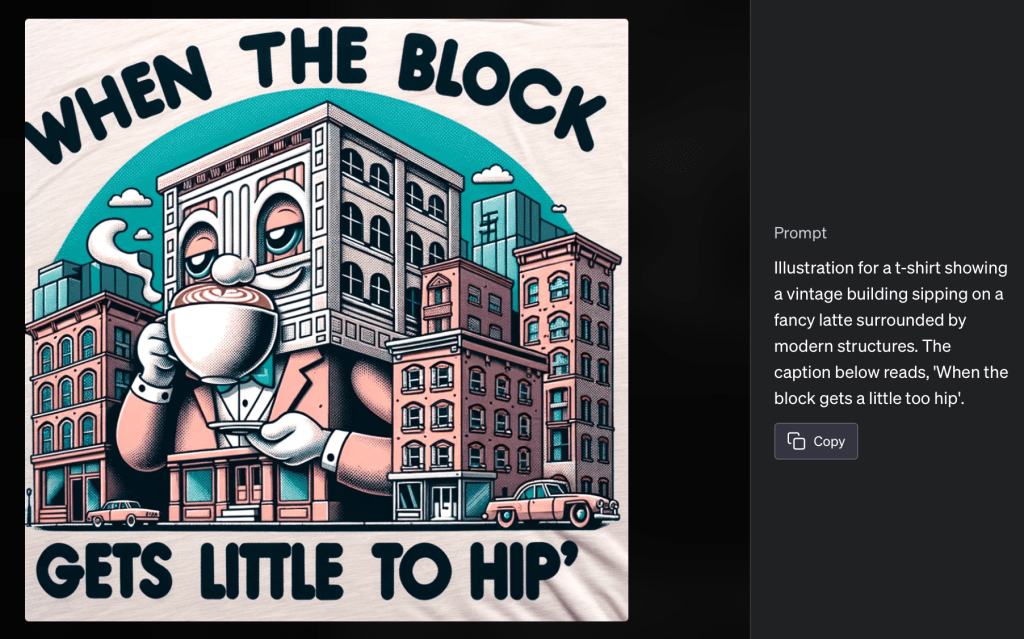
    I asked DALL-E 3 to create a meme illustration about gentrification

    Ok, so this development is already a month (or so) old, so I’m a bit late to the party. But hey, better late than never.

    In this article I’m including some memes and illustrations (particularly interesting for POD designers, and, well, illustrators).

    How To Use DALL-E 3

    First things first — here is how you can access DALL-E 3. It’s fairly simple.

    1. Go on ChatGPT. You need to have the subscription in order to use DALL-E 3, at least at the time of writing this.
    2. Make sure to select ChatGPT 4 as a model in the upper left corner.
    3. Write a prompt! It’s perfectly fine to keep it simple, you will achieve interesting results anyway, as ChatGPT will do the thinking for you

    Example Prompts for DALL-E 3

    A simple short prompt will go a long way. Try things like:

    • Create an image of a hedgehog in the rain
    • Make a meme about a messy kitchen
    • Create a logo for my bakery
    • Create a meme about my friend Janet who is always late

    Especially the latter point is proving to be very interesting for me, as I love surprising my friends with some crazy imagery. Best thing you can do is experiment a bit, and see what comes out. Oftentimes the results are entertaining.

    Memes

    So the first thing I’ve tried was to generate memes, as I keep seeing AI-generated memes all over my social media. 

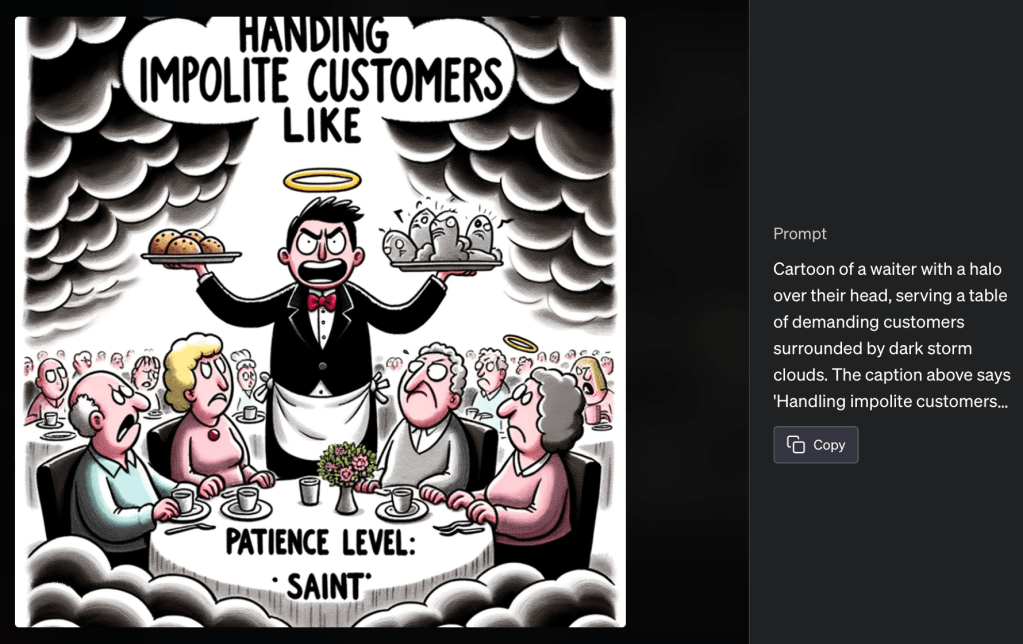
    As you can see there are barely any typos, which is pretty impressive

    And the beautiful thing here is that ChatGPT comes up with its own prompt, adding new thoughts to your idea. At this point, it basically does all the (conceptual) thinking. 

    You might be wondering: how is DALL-E handling text / alphabet characters displayed in images? Well, it got waay better, although of course there are occasional glitches. Compared to earlier versions of DALL-E though this is a significant improvement. I also like the font used here.

    As you can probably guess, the sky is the limit here. Generating this type of content like this could be a game-changer for anyone who wants to run, say, a meme Instagram account.

    Illustrations and Shirt Designs

    But wait, there’s more. Memes obviously weren’t enough, so I went straight ahead to shirt design illustrations. And as a “seasoned artist”, I have to say I’m impressed. To check for possible copyright breaches, I performed a Google image search for several of these designs, and found nothing similar enough.

    For this one, I told ChatGPT to create a meme about gentrification:

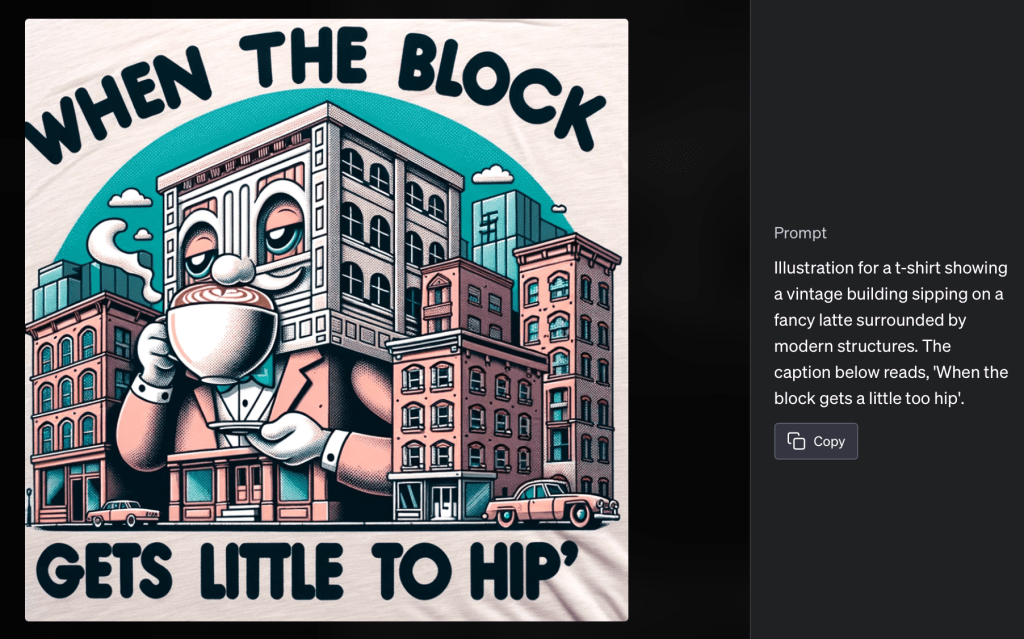
    ChatGPT came up with the slogan “When the block gets a little too hip”, pretty funky idea

    And here is an illustration about marketing, or made FOR the marketer. This one is a bit more glitchy, maybe because of the amount of words involved:

    And while it has errors and glitches, it’s conceptually still a great idea that could work well on a shirt. Personally for me I have decided that I definitely will use this as an inspiration for my actual designs.

    Of course I made more than these images, so if you’re curious, you might as well ask me. You can get in contact via my contact form

    or Instagram, for example: https://www.instagram.com/swetlana_ai/

    Here’s one more about boomers and millennials:

    ChatGPT and DALL-E 3

    Here’s what all the fuzz is about: ChatGPT now offers a unique image creation feature for Plus and Enterprise users. Simply describe your vision, and ChatGPT will provide visuals for you to refine and request revisions in the chat.

    DALL·E 3 is a highly advanced image model resulting from extensive research, offering visually stunning and detailed images. It excels in handling detailed prompts, supports various aspect ratios, and focuses more on user-supplied captions

    With DALL·E 3, you can unleash your creativity like never before. The only BUT: it doesn’t replicate the style of living artists. Additionally, you have the option to exclude your images from future model training. Learn more in their research paper here.

    Here’s the summary of the research paper: 

    Recent advancements in generative modeling have significantly improved text-to-image generative models. These improvements stem from two main approaches: using sampling-based methods like autoregressive generative modeling or diffusion processes, which break down image generation into manageable steps for neural networks. Additionally, researchers have developed image generators based on self-attention layers, separating image generation from convolutional spatial biases and leveraging transformer scaling properties.

    When coupled with large datasets, these approaches enable the training of text-to-image models that can produce imagery approaching human-quality photos and artwork. However, a key challenge in this field is “prompt following,” where models often struggle to capture word meanings, order, or context in given captions.

    Several works have highlighted this challenge, proposing various solutions. This paper introduces a novel approach to address prompt following: caption improvement. The authors believe that the poor quality of text-image pairings in training datasets is a fundamental issue. To tackle this, they develop a robust image captioning system to generate detailed, accurate descriptions for images, enhancing the dataset’s captions. Subsequently, they train text-to-image models on this improved dataset.

    While training on synthetic data is not new, this work focuses on the development of a descriptive image captioning system and assesses the impact of using synthetic captions in training generative models. The paper primarily evaluates the enhanced prompt following capabilities of DALL-E 3, achieved through training on highly descriptive generated captions. It does not delve into the technical details of the DALL-E 3 model but provides an overview of the training strategy, evaluations, and discussions of limitations and risks.