Tag: ai video

  • AI & Creative Process

    Generative AI makes almost anything possible. You just need to know the tools and be clear about what you want to say.*

    [*In addition to it, you’ll of course need motivation, agency, and taste, but let’s save this discussion for next time.]

    For better or worse, art/culture is about to change, and I’m changing with it.

    For the context: Among other things, I’m also a “real artist”, aka an artist who has been creating without AI – for quite some time. Luckily, I’m very pro-tech (grew up with computers thanks to my dad), and have no unresolved conflicts pertaining to creativity, which is why I’ve experienced a pretty smooth conversion from “real art” to AI content.

    I’m mentioning this because a huge chunk of “real artists” continues to be outraged about AI. But that’s something for a future blog.

    In the past few months I’ve been using AI to create a lot of stuff (see “Projects”). Since I’m very active on Twitter/X (by the way, let’s connect), I tend to learn about new tools very early, and in many cases I head straight to the tool to try it out.

    General Observations

    Experimenting, or as some call it “tinkering”, is essential. We are entering a new terrain of artistic expression, with a lot (most?) of it still unexplored.

    Imagine what it must have felt like when photography was invented. As cameras became more accessible and photography moved from early adoption into the mainstream, people began to test its boundaries. 

    They didn’t just replicate paintings. They played with light, blur, composition, even accidents. That’s how entirely new aesthetics emerged.

    The same applies to AI tools today. The real breakthroughs don’t come from following tutorials step by step, but rather from misusing tools, playing with prompts, layering outputs, remixing styles, and exploring the “wrong” ways of doing things. 

    Tinkering isn’t aimlessness, it’s a tool of discovery. 

    It’s how genres are born, how formats mutate, and how we can stretch the limits of what feels possible.

    What I’ve Learned

    Things are changing fast, but for the foreseeable future these insights will probably hold true.

    Assuming you want to enter the space and try creating something, 

    • Many platforms offer free daily credits, and you should make use of those.
    • Have a structured collection of AI tools. In my case it’s a bookmarks folder.
    • Definitely also structure your computer folders. You might end up with a lot of images and videos. Don’t get lost in the jungle.
    • Spend time away from your computer and write down your ideas on paper. In my case being in the nature really helps to not get lost in the detail. 
    • Recognize the difference between “gimmick” and “substance”.  I see people post AI videos on X, and most of them are gimmicks (= they don’t have any message, and/or are just tropes). Now you don’t have to have ambitions to create anything of substance. But some discernment really helps here either way.
    • Spend some time thinking about taste and what it implies. 
    • Have ChatGPT write your image / video prompt. Your job is to tell it your idea, intent, message. This middle step adds a big layer of detail.
    • Get familiar with JSON. Prompts in JSON format are the ideal language when talking to AI.
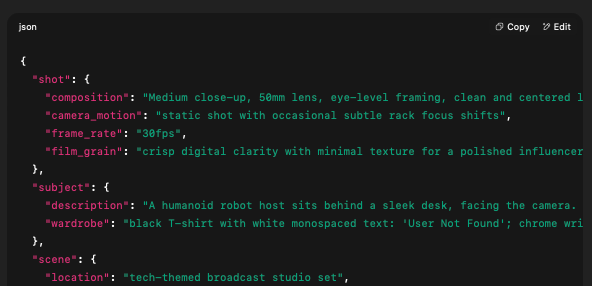
    What a prompt in JSON format looks like. This one is for a video.

    I will surely dedicate another post to the insights I’ve had while using all the different AI tools. For now let’s keep it concise. 

    Finally, below is a list of some of the AI tools I’m using. Give them a try; they all have a free tier.

    AI Tools I Use

    Voice & Script Generation: I use Google’s NotebookLM, a free tool that transforms PDFs, websites, or text into audio summaries. This makes scripting and voice generation easy, even for complex topics. For cases when I need a custom voice (and for all things text-to-speech), Elevenlabs is my go-to.

    Music Creation: Tools like Suno and Udio enable me to generate background music for any mood, or entire songs, if I happen to have any song idea. You can use lyrics or create instrumental tracks.

    Video Generation: Platforms such as Runway, Luma, and Kling AI allow video creation and animation, offering a variety of capabilities depending on the project. These days I also increasingly use Dreamina by ByteDance/CapCut.

    Image Generation: I prefer Ideogram, Flux, Reve, and Leonardo.ai for diverse artistic styles. ChatGPT image generation is great for Ghibli-style illustrations or comics. Unlike Midjourney, which tends to create polished, predictable images, these tools yield more unexpected and raw visuals, perfect for experimental art.


    That’s it for now! If you want to *listen* to me talk about my creative process, here’s a video I made some time ago:

  • “True Art” & Generative AI: Why Most Creators Are Kinda Meh

    “True Art” & Generative AI: Why Most Creators Are Kinda Meh

    Let’s talk about creativity and gen AI. 

    I’m observing people doing stuff with gen AI. Some of them are artists, some of them are probably “tech people” (without any art background). 

    [*not gonna name anyone specific to not accidentally discredit them.]

    People’s AI output that I’ve seen is always (without exceptions) either:

    a) boring and unoriginal (e.g. Star Wars tropes, short scenes without context), or

    b) too “crazy” (intriguing, but lacking something)

    Today I’d like to unpack what’s going on there, and why we’re not even scratching the surface of what’s possible in terms of AI video (and filmmaking).

    So… What’s lacking?

    Obviously, I asked ChatGPT to provide structure and thought clarity into this gigantic ball of thoughts. Here we go:

    Creating “True Art” with Gen AI

    Creating “true art” with generative AI, art that resonates deeply with people, requires balancing several elements: originality, emotional depth, relatability, and perhaps a touch of unpredictability.

    Let’s unpack why some AI-generated content feels empty and why others, while unique, may fail to connect.

    The Pitfalls of AI Art

    1. Empty Tropes: When creators rely heavily on popular or well-worn themes (like Star Wars-like scenes), they often produce work that lacks innovation. These pieces may be visually impressive but fail to evoke deeper emotions or provoke thought. They’re predictable and don’t challenge the viewer’s expectations.
    2. Excessive Novelty: On the other hand, work that’s too avant-garde can alienate viewers. It may be technically or conceptually interesting, but if it doesn’t provide an entry point for emotional or intellectual engagement, it can leave the audience feeling disconnected.

    The Missing Element: Emotional Connection

    The key to creating art that resonates is often emotional depth. Art that touches people tends to:

    • Evoke Emotion: It could be joy, sadness, nostalgia, or awe. The emotional response is what makes art memorable and impactful.
    • Tell a Story: Even abstract or experimental art can hint at a narrative or evoke a world that feels coherent, giving viewers something to latch onto.
    • Foster Relatability: While the art should be original, it should also connect to universal themes or emotions that people can recognize and relate to.

    Formula for True Art with Generative AI

    1. Start with a Core Emotion: Decide what feeling you want to evoke. Is it wonder, melancholy, curiosity? Anchor your creation process around this emotion.
    2. Blend Familiar with Unfamiliar: Incorporate elements that are recognizable but present them in a new or unexpected way. This balance keeps the audience grounded while piquing their curiosity.
    3. Narrative Layering: Even abstract pieces can suggest a story. Use generative AI to create layers of meaning that viewers can interpret, making the piece richer and more engaging on repeated viewings.
    4. Engage Multiple Senses: Consider how to engage not just visually but also aurally (through music or sound design) and conceptually (through intriguing ideas or themes). Multi-sensory engagement deepens the emotional impact.
    5. Iterate and Reflect: Use AI’s capability to generate variations to experiment. Reflect on which versions resonate more and why. This iterative process helps refine the emotional and conceptual punch of the work.
    6. Seek Feedback: Share your work with a small audience and gauge their reactions. Understanding how others perceive your art can help you fine-tune its impact.

    Breaking the Cycle

    To break the cycle of underwhelming AI art, focus on authenticity and intention. Instead of merely pushing boundaries for the sake of novelty or adhering to familiar templates, aim to create work that speaks to deeper truths or experiences. Authenticity in art, even when generated by AI, shines through when there’s a clear intention and emotional resonance behind it.

    In essence, “true art” with AI isn’t just about what the AI can produce; it’s about what you, as the creator, bring to the table—your vision, your emotional insights, and your ability to craft a narrative or experience that feels meaningful. The genius lies in using AI as a tool to amplify and realize that vision, rather than relying on it to do all the heavy lifting.


    Spectrums of “True Art”

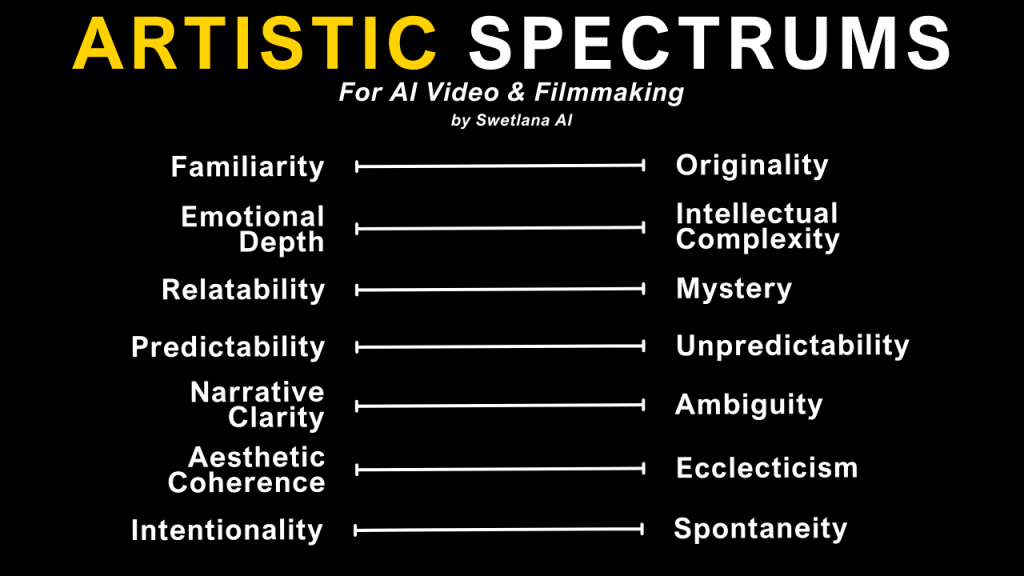
    To measure the elements that contribute to creating “true art” with generative AI, you can think of them along several spectrums. These spectrums allow you to evaluate and balance different aspects of the creative process:

    1. Originality vs. Familiarity

    • Originality: The degree to which the art introduces new, unconventional, or surprising elements.
    • Familiarity: The degree to which the art draws on recognizable themes, motifs, or emotions that the audience can easily relate to.

    Goal: Find a sweet spot where the art is innovative but still accessible, engaging viewers through a mix of the new and the familiar.

    2. Emotional Depth vs. Intellectual Complexity

    • Emotional Depth: The extent to which the art evokes strong emotional responses, making it memorable and impactful.
    • Intellectual Complexity: The degree to which the art engages the viewer’s intellect through intricate concepts, symbolism, or narratives.

    Goal: Balance emotional engagement with intellectual stimulation to create art that resonates on multiple levels.

    3. Relatability vs. Mystery

    • Relatability: How easily the audience can connect with the themes, emotions, or experiences depicted in the art.
    • Mystery: The extent to which the art leaves room for interpretation, inviting curiosity and exploration.

    Goal: Create art that is relatable enough to draw viewers in but mysterious enough to sustain their interest and provoke thought.

    4. Predictability vs. Unpredictability

    • Predictability: The use of familiar structures, tropes, or elements that make the art feel safe and understandable.
    • Unpredictability: The introduction of unexpected twists, innovations, or deviations from norms that surprise and intrigue the audience.

    Goal: Strike a balance where the audience feels comfortable but also experiences moments of surprise or wonder.

    5. Narrative Clarity vs. Ambiguity

    • Narrative Clarity: How clearly the story or message of the art is conveyed, making it easy to follow and understand.
    • Ambiguity: The level of openness in the narrative, allowing for multiple interpretations and deeper engagement over time.

    Goal: Allow for clarity in key themes while maintaining enough ambiguity to invite personal interpretation and ongoing discovery.

    6. Aesthetic Coherence vs. Eclecticism

    • Aesthetic Coherence: The consistency in style, color palette, form, or theme that gives the art a unified feel.
    • Eclecticism: The use of diverse styles, elements, or influences to create a more varied and dynamic piece.

    Goal: Ensure the art has a cohesive identity while allowing for diverse influences that enrich its appeal.

    7. Intentionality vs. Spontaneity

    • Intentionality: The extent to which the art is planned, deliberate, and aligned with a specific vision or message.
    • Spontaneity: The incorporation of random, unplanned elements that can add vitality and freshness to the art.

    Goal: Combine a clear artistic vision with spontaneous, unexpected elements that keep the work alive and engaging.

    By using these spectrums as guides, you can critically assess and refine your generative AI art, ensuring it has the depth, balance, and resonance needed to connect with an audience.